When Is a Heavy Jet Actually Worth It?
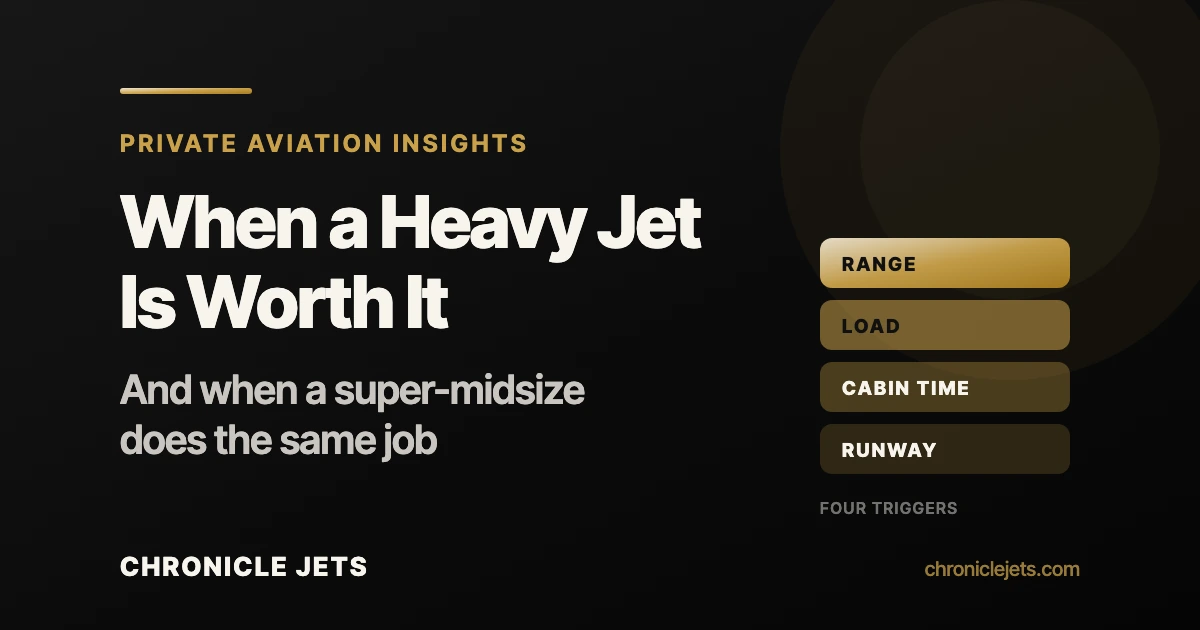
A heavy jet is worth it when your trip genuinely needs its range, its payload, its cabin over many hours, or its performance on a demanding runway. If none of those four apply, a super-midsize usually flies the same trip for less. The answer depends on the specific leg, load, and airports, not on how important the trip feels.
TLDR:
- A heavy jet earns its cost through four triggers: range, passengers plus luggage, cabin time, and runway performance.
- Published super-midsize ranges top out between 3,400 and just over 4,000 nautical miles, under light-load assumptions.
- Seats rarely force the upgrade. Fuel, people, and bags share one weight limit, and that limit is what runs out.
- Trips longer than a two-pilot crew’s 10-hour federal flight-time limit require a bigger crew and somewhere for a pilot to sleep.
- Hot, high, or short runways shrink what any aircraft can lift, and a long leg means more fuel to lift.
- A planned fuel stop on a rare long trip can cost less than sizing up for every trip.
- Ask for the plan on your actual leg, load, and airports before you accept a bigger aircraft.
For flyers based in Central Florida, the heavy jet question usually arrives with a specific trip attached. Europe with the family, South America for business, or a long domestic run with a full cabin and golf bags. Each of those can point toward a bigger aircraft, and not every one of them actually requires it.
Our guide to matching an aircraft to the mission covers what each category does. This piece answers the narrower question it leaves open: when is the step-up to a heavy jet worth paying for, and when is it not?
Size the aircraft to the trip, not the brochure
What Does Range Really Buy You?
Range is the trigger most people think of first. It is also the one most often misjudged, because the published number is the best case.
Every range figure a manufacturer publishes rests on assumptions. Bombardier lists the Challenger 3500 at 3,400 nautical miles on its 2026 specification page, then qualifies it: four passengers, NBAA IFR fuel reserves, and a warm-day takeoff. Change the load or the winds and the real number moves.
The top of the super-midsize class sits close to the bottom of the heavy class. Textron Aviation publishes the Citation Longitude at 3,500 nautical miles, and Embraer describes the Praetor 600 as the first jet in its class with a range over 4,000 nautical miles. Dassault’s 2026 specifications list the Falcon 2000LXS, a heavy jet, at 4,000 nautical miles with six passengers.
Past that line, the case for a heavy jet gets clear. Dassault rates the Falcon 900LX at 4,750 nautical miles, and Bombardier’s 2017 overview put the Global 6000 at 6,000 nautical miles. General Dynamics credited the Gulfstream G650ER with 7,500 nautical miles of range and a 5,940 nautical mile Newark to Tokyo record run in 2017.
The overlap in the middle is the point. If your leg sits beyond roughly 4,000 nautical miles, or near that line with a full cabin and strong headwinds, a heavy jet is the category that flies it nonstop. Below it, the real choice is a nonstop in a bigger aircraft or a planned fuel stop in a smaller one.
Why Are Passengers and Luggage One Constraint, Not Two?
Seat count is the number buyers quote. Weight is the number that decides the aircraft.
The FAA’s 2016 Aircraft Weight and Balance Handbook says it plainly: most modern aircraft are designed so that with every seat occupied, the baggage compartment full, and all fuel tanks full, the aircraft is grossly overloaded. If maximum range is required, occupants or baggage must be left behind.
Textron’s own figures show how fast that bites. The Longitude carries a maximum payload of 3,200 pounds, but 1,600 pounds with full fuel. Half the payload disappears the moment the tanks are filled for a long leg.
That is why eight passengers with carry-ons and eight passengers with ski bags, golf clubs, or a week of luggage can need two different aircraft. The seats are the same. The weight is not, and on a long leg the fuel is competing for that same weight.
So the trigger here is the combination. A heavy jet is worth considering when your full passenger list, their real luggage, and the fuel for the leg cannot all fit inside a smaller aircraft’s limits at once. The operator’s weight and balance calculation answers that question, not the seat map.
Send us the passenger list and the bags
When Is the Cabin the Point?
On a two-hour hop, cabin size is comfort. On an overnight crossing, it becomes part of how the flight is legally staffed.
Under 14 CFR 135.267, a two-pilot crew flying on-demand charter is limited to 10 hours of flight time in any 24 consecutive hours. Longer assignments move to three- or four-pilot crews under 14 CFR 135.269, which allows up to 12 or 16 hours aloft and requires adequate sleeping facilities on the aircraft for the relief pilot.
That turns cabin space into a practical requirement. A relief pilot needs a place to rest, and passengers on a long overnight leg want somewhere to sleep that is not their dinner seat.
A flat surface to sleep on is not exclusive to heavy jets, which is worth knowing before paying for one. Textron describes the Longitude’s fully berthable seating, and Bombardier lists a three-place divan with berthing capability as an option on the Challenger 3500.
What a heavy jet adds is length. Dassault lists the Falcon 900LX cabin at 33 feet 2 inches long, against 25 feet 2 inches for both the Longitude and the Challenger 3500 on their manufacturers’ pages. Standing height is close to six feet across all three.
That extra length is what lets some passengers sleep while others work or eat. So the cabin trigger is time: an overnight or intercontinental leg where people need real rest makes the heavy cabin worth it. A four-hour daytime flight usually does not.
How Do Runway and Payload Decide Some Trips for You?
Some trips make the aircraft choice before anyone looks at the cabin. The runway and the weather at departure can do it on their own.
The FAA’s Pilot’s Handbook of Aeronautical Knowledge performance chapter, published in 2016, explains why. High elevations and high temperatures raise density altitude, and as density altitude rises, aircraft performance falls. Weight compounds it: a 10 percent increase in takeoff gross weight produces at least a 21 percent increase in takeoff distance.
A long leg means more fuel, and more fuel means more weight on a runway that has not gotten any longer. A hot afternoon, a mountain airport, or a short strip near the destination can each limit what an aircraft can carry out, sometimes enough to force a fuel stop or a smaller load.
Bigger does not automatically mean more runway. At maximum weight on a standard sea-level day, Dassault lists 4,675 feet of takeoff distance for the Falcon 2000LXS, while Textron lists 4,810 feet for the Longitude and Bombardier lists 4,835 feet for the Challenger 3500.
Some heavy jets are built for demanding airports. Bombardier’s 2017 overview notes the Global 6000 is steep-approach certified for airports like London City and Aspen. When the destination is restrictive and the leg is long, that capability can settle the question.
When Does a Super-Midsize Do the Same Job?
This is the section most people selling aircraft time would rather skip. If your trip does not hit one of the four triggers, a super-midsize is usually the right call, and it is not a compromise.
A planned fuel stop is not a failure of planning. On a rare long leg, one stop in a super-midsize can cost less in total than chartering a heavy jet for the whole trip, especially when the rest of your flying is shorter. The only honest test is to price the same itinerary both ways and compare what an all-in quote should contain on each.
The Atlantic is not automatically heavy jet territory either. Textron markets the Longitude with transatlantic range, and Embraer cites Paris to New York as a normal trip for the Praetor 600. Winds and load on your date decide if that holds, which is exactly what the operator’s flight plan tells you.
Here is how the four triggers sort a trip. Read across each row and see which side your trip lands on.
| Trigger | Points to a heavy jet | Points to a super-midsize |
|---|---|---|
| Range | Leg beyond about 4,000 nm, or near it with a full load | Leg well inside published super-midsize range |
| Passengers and bags | Full group, real luggage, and full fuel exceed the limits | Load fits with the fuel the leg needs |
| Cabin time | Overnight leg past 10 hours, people need to sleep | Daytime leg of a few hours |
| Runway | Demanding airport and a long leg together | Long runways at both ends |
One clear heavy-jet answer is usually enough to justify the step-up. Two maybes rarely are.
If your trip lands on the right-hand side, our super-midsize options include aircraft like the Challenger 350. If a trigger genuinely applies, heavy jet charter is where we start. We would rather tell you a smaller aircraft fits than sell you hours you do not need.
Common Questions About Choosing a Heavy Jet
These are the questions that come up when a trip sits near the line between a super-midsize and a heavy jet. Each one comes back to the same four triggers.
How far can a heavy jet fly nonstop?
It depends on the aircraft. Manufacturer figures run from 4,000 nautical miles for the Falcon 2000LXS to 7,500 for the Gulfstream G650ER. Those numbers assume specific loads and fuel reserves, so the real range on your date depends on weight, winds, and temperature.
Do I need a heavy jet to fly to Europe?
Not always. Some super-midsize jets are marketed with transatlantic range, including the Citation Longitude and the Praetor 600. The deciding factors are the exact city pair, the season’s winds, and your load. If those push past the aircraft’s limits, the options are a fuel stop or a heavy jet.
How many passengers makes a heavy jet necessary?
No passenger count settles it alone. Bombardier lists the Challenger 3500 for up to 10 passengers, but fuel, people, and bags share one weight limit. A heavy jet becomes the right call when your group, their luggage, and the fuel for the leg will not fit together.
Is a heavy jet safer than a super-midsize?
Aircraft size is not a safety rating. On-demand charter flights in both categories operate under the same FAA Part 135 rules. What matters for safety is the operator, its crew, and its audit history, which is why the operator deserves its own scrutiny separate from the aircraft choice.
Can a heavy jet use smaller airports?
Some can. Bombardier notes the Global 6000 is steep-approach certified for airports like London City and Aspen. Runway length, elevation, temperature, and the fuel load for your leg all set the limit, so the answer is specific to the airport and belongs in the quote.
Tell us the trip and we will size it honestly