How Does Booking a Private Jet Charter Actually Work?
You send the trip details; you get back aircraft options rather than a single price; you choose one; you sign a contract and pay; and a trip sheet confirms the details before departure. The stage most people skip past is the contract, because federal rules require a charter broker to disclose six specific things before you sign. Three of those arrive automatically. The other three only if you ask for them.
TLDR:
- Send the route, dates, passenger count, and luggage up front. Those four decide almost everything else.
- A good quote comes back as options at different price points, not one number.
- Chronicle Jets is an air charter broker under DOT Part 295. We do not own or operate aircraft; certificated Part 135 carriers do the flying.
- Before you sign, federal rules require three disclosures automatically, including the corporate name of the carrier that will actually operate your flight.
- Three further disclosures must be provided on request, including any business relationship between the broker and that carrier.
- A trip sheet confirms aircraft, times, airports, and crew before departure.
- If the flight cannot be performed, regulations set the refund timing for cash and check payments at 20 days after a complete request.
- Short-notice trips are possible. The limits are aircraft availability and crew duty rules, not paperwork.
Chartering is opaque until you have done it once. People arrive expecting something like booking a flight, find a process that feels more like commissioning a service, and are not sure which parts are normal.
Here is the whole sequence, and the points in it where asking one question changes what you get.
Planning a trip? Send the route, dates, and passenger count. We will come back with aircraft options and what each one costs.
Step 1: The Inquiry
Four details do most of the work: where you are going, when, how many people, and what luggage is coming.
The fourth is the one people leave out, and it is the one most likely to change the aircraft. Golf clubs, ski equipment, sample cases, and instruments all take up space that the seat count does not capture.
Tell us anything fixed and anything flexible. A departure time that can move by two hours sometimes changes the price meaningfully. If you are coordinating on someone else’s behalf, our guide for executive assistants booking charter covers the workflow from that side.
Step 2: The Quote Comes Back as Options
A single price in response to an open question usually means someone guessed. What should come back is a handful of aircraft that can do the trip, with what each one costs and the trade-offs.
That is where the real decision happens, because the differences between categories, from light jets up to heavy jets, are rarely what people expect. Our comparison of light jets and midsize jets follows a typical version of that choice, and matching a jet to the mission covers the four inputs that drive it.
Read the quote structure as carefully as the number. Comparing an hourly rate with an all-in quote clarifies what belongs inside the total and what typically sits outside it.
Step 3: Holding the Aircraft
Aircraft are held, not reserved indefinitely. Once you indicate a choice, we confirm availability with the operator, and the aircraft is held briefly while we prepare the contract.
This is why a quote that looked good on Monday may not be available on Thursday. Nothing improper happened. The aircraft was sold to whoever committed first.
Step 4: The Contract, and What You Are Owed Before You Sign
This is the stage worth slowing down on, and the one almost no charter guide explains.
Chronicle Jets is an air charter broker operating under U.S. Department of Transportation Part 295 regulations. We do not own or operate aircraft. FAA-certificated Part 135 air carriers do the flying. That structure is standard for brokers, and it comes with specific legal obligations.
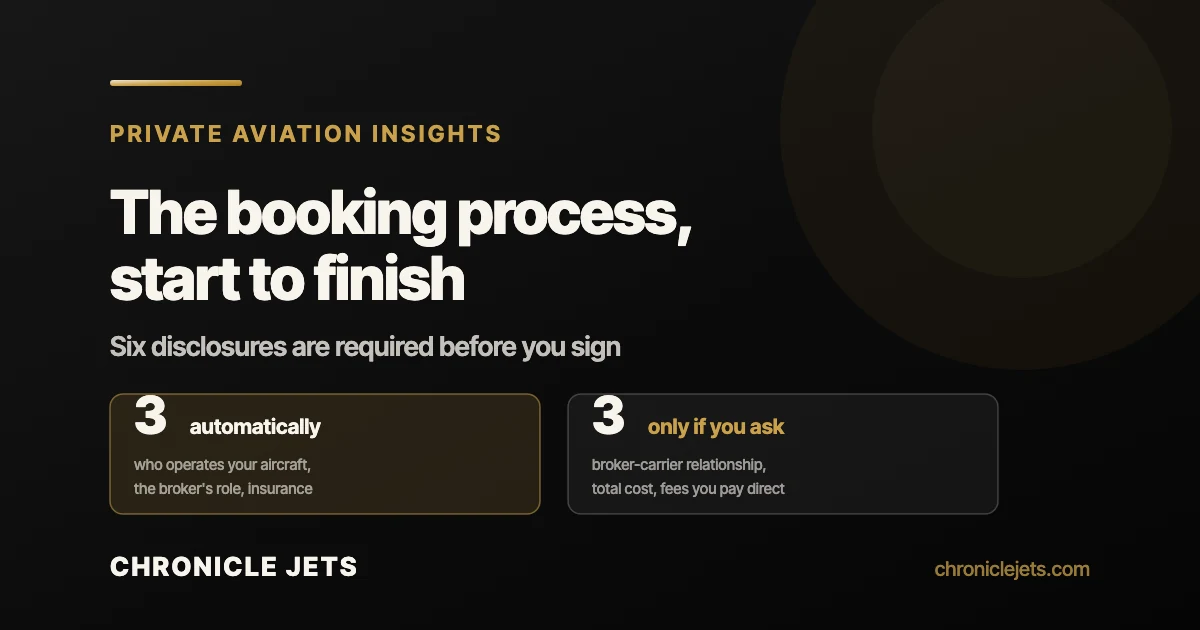
14 CFR 295.24 sets out six disclosures. The split between them matters:
Three you get automatically, before the contract:
- The corporate name of the direct air carrier that will be in operational control of the aircraft, along with any other names it holds itself out under.
- The capacity the broker is acting in, meaning as an indirect air carrier, as your agent, or as the carrier’s agent.
- The existence or absence of liability insurance.
Three more, but only if you ask:
- Any corporate or business relationship between the broker and the operating carrier that may bear on which carrier was selected.
- The total cost you are paying, including broker or carrier fees and government taxes.
- Any third-party fees you will pay directly, such as fuel, landing fees, or parking, with a good-faith estimate where the exact figure is not known.
Look at what is in the second list. The relationship between the broker and the carrier, the full cost, and the fees you pay directly are all available to you, and all three stay unsaid unless you request them.
So ask. A broker who answers those three plainly is the one you want. The regulation also makes misrepresenting who operates the aircraft, the type of aircraft, or the pilots’ qualifications an unfair or deceptive practice.
If you want the safety diligence that belongs alongside this, how charter brokers vet operators covers what ARGUS and Wyvern ratings do and do not prove.
Step 5: Payment, and What Happens If the Flight Cannot Be Flown
Payment terms vary by trip and operator, so ask for yours in writing rather than assuming a standard.
Refunds are not left entirely to custom. 14 CFR 295.26 requires brokers to make prompt refunds when transportation cannot be performed, or a refund is otherwise due, and sets a specific deadline for cash and check purchases:
within 20 days after receiving a complete refund request
Credit card refunds follow separate rules referenced in the same section. The phrase doing the work is “a complete refund request,” so submit the request in full rather than in pieces.
Step 6: The Trip Sheet
Before departure, you should receive confirmation of the specifics: the aircraft and tail number, departure and arrival airport(s) (including the specific terminal), times, crew, and any catering or ground transport arranged.
Read the airport line carefully. Metropolitan areas have several fields, and they are not equally convenient. A twenty-minute difference on the ground can undo the time chartering was meant to save.
Step 7: Day of Departure
Arrive at the private terminal rather than the main one, usually shortly before departure rather than hours ahead. There is no commercial security queue, and boarding is a walk to the aircraft.
If anything slips on your side, tell your broker early rather than at the gate. Crews work under duty and rest limits, and a delay that is manageable at the first phone call can become an overnight if nobody hears about it until departure time.
Step 8: After the Flight
A final invoice reconciles what was quoted against what happened: ground time used, any de-icing, airport charges as billed, and anything added along the way.
That reconciliation is normal, and it is where most billing surprises live. What can change your charter quote after you book covers which lines can legitimately move and how to cap them before you sign.
How Long All of This Takes
Less time than people expect. An inquiry can turn into options the same day, and a straightforward domestic trip can be arranged within twenty-four hours when aircraft are available.
The constraints on short notice are aircraft positioning and crew duty availability, not paperwork. Booking further ahead buys more choice and usually a better price, not a faster process.
Once you have the operator’s name, you can check its certificate yourself. Our Part 135 explainer shows how, using the FAA’s own operator list.
Common Questions About Booking a Charter Flight
What people ask us most before their first charter.
How far in advance should I book a private jet?
Booking earlier gives you more aircraft to choose from and usually a better price. A straightforward domestic trip can often be arranged within twenty-four hours when aircraft are available. Short-notice limits are positioning and crew duty availability, not paperwork.
Who actually operates my flight if I book through a broker?
A certificated air carrier, not the broker. Federal rules require a broker to disclose the corporate name of the carrier in operational control of your aircraft before you enter the contract, along with any other names that carrier trades under.
What do I have to ask for rather than being told?
Three of the six required disclosures are provided only on request: any business relationship between the broker and the operating carrier, the total cost including fees and taxes, and any third-party fees you will pay directly. Ask for all three.
What information do you need from me to quote?
Route, dates and times, passenger count, and luggage. Luggage is the one most often left out and the one most likely to change the aircraft. Mention anything unusual such as sporting equipment, instruments, or pets.
What happens if my flight cannot be flown?
Brokers are required to make prompt refunds when transportation cannot be performed. For cash and check purchases,s the regulation sets 20 days after receiving a complete refund request. Credit card purchases follow separate referenced rules.
Do I need to arrive early like a commercial flight?
No. You arrive at a private terminal shortly before departure rather than hours ahead, and boarding is walking to the aircraft. Check the terminal on your trip sheet, because larger metropolitan areas have several.
Can I change the trip after booking?
Usually yes, and changes have cost consequences that depend on what moves. Timing, airports, passenger count, and luggage each affect the aircraft and the price differently. Tell your broker as early as possible.
Ready to start, or want the options? Send the route, dates, and passenger count, and we will come back with aircraft that fit and what each one costs.