What Is Part 135 in Private Jet Charter?
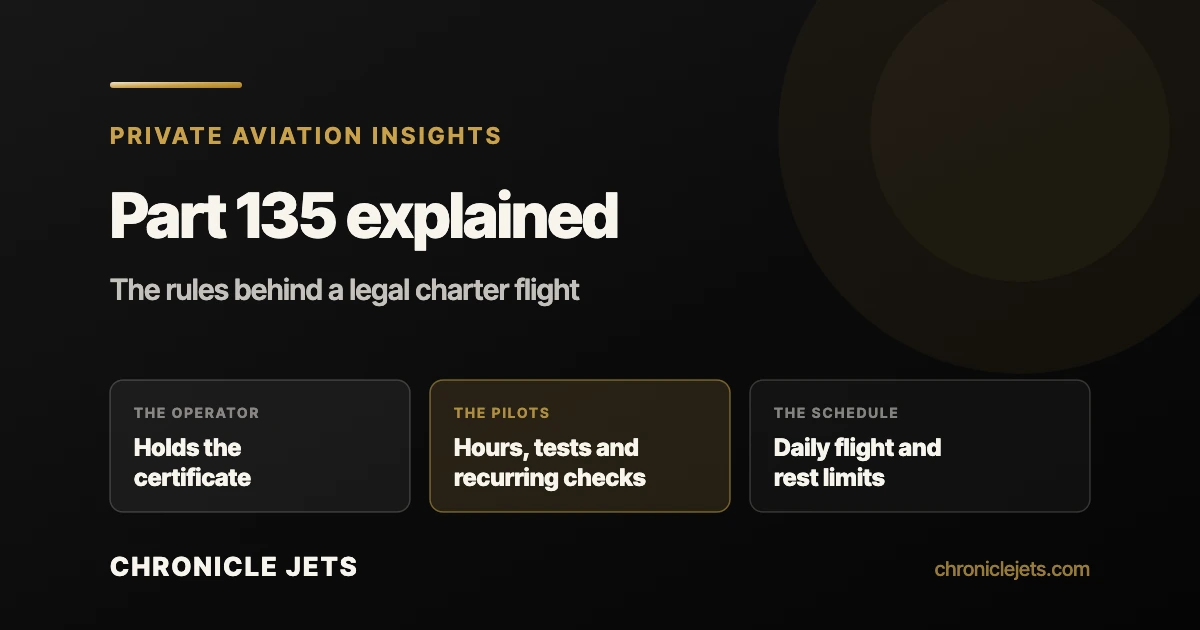
Part 135 is the section of federal aviation rules that governs on-demand charter. A company that flies passengers for hire has to hold an FAA certificate under it, and that certificate comes with rules on pilot experience, recurring testing, daily flight and rest limits, and aircraft upkeep. When you pay for a charter, the aircraft and crew should be flying under a Part 135 certificate.
TLDR:
- Part 135 covers on-demand charter. The company flying you for hire must hold an FAA Air Carrier or Operating Certificate.
- The certificate holder, not the broker, is responsible for operational control of the flight.
- A pilot in command of a charter jet needs an airline transport pilot certificate. Smaller aircraft still require 500 hours for visual flights and 1,200 for instrument flights.
- Charter pilots retest every 12 calendar months and take an instrument check every 6.
- A crew of one or two pilots can fly 8 or 10 hours in any 24, with rest rules around each duty day.
- You can check any operator yourself on the FAA’s Part 135 list, which is updated weekly.
Most charter clients never read a federal regulation, and they should not have to. The rules still shape the trip, from who is allowed to fly you to how long a crew can stay on duty before a long day calls for a second plan.
This guide covers what Part 135 asks of the operator and its pilots, how it differs from a private Part 91 flight, and the checks you can run yourself before you book.
Ask which operator will fly your trip
Who Holds the Part 135 Certificate, and Why It Matters
The certificate belongs to the operator, the company that flies the aircraft. Under 14 CFR 119.5, a company authorized to fly as a direct air carrier is issued an Air Carrier Certificate, and no one may operate as a direct air carrier without one.
That certificate holder is also responsible for operational control. 14 CFR 135.77 puts it plainly: each certificate holder is responsible for operational control and has to list, in its manual, the people authorized to exercise it.
Where a broker fits
A broker arranges the flight. The operator flies it. Chronicle Jets is an air charter broker, not a direct air carrier, so every trip we arrange is flown by a licensed operator holding its own certificate. Our guide on the difference between a broker and an operator covers how that split works in practice.
What Part 135 Requires of the Pilots
The pilot rules are where Part 135 gets specific. Under 14 CFR 135.243, as published in the eCFR in 2026:
- Jets and larger aircraft: the pilot in command of a turbojet, or of an airplane with 10 or more passenger seats, must hold an airline transport pilot certificate.
- Visual flights in other aircraft: at least a commercial pilot certificate and 500 hours as a pilot, including 100 hours cross-country and 25 at night.
- Instrument flights in other aircraft: at least a commercial pilot certificate and 1,200 hours, including 500 cross-country, 100 at night, and 75 hours of instrument time.
The checks that repeat
Hours are only the entry point. Part 135 also requires recurring checks:
- A written or oral knowledge test every 12 calendar months (14 CFR 135.293), covering the rules, the operator’s manual, and each aircraft type the pilot flies.
- An instrument proficiency check every 6 calendar months for a pilot in command flying under instrument rules (14 CFR 135.297).
- A line check every 12 calendar months, flown over a route segment with an approved check pilot (14 CFR 135.299).
How Long a Charter Crew Can Fly in a Day
Rest rules are the part of Part 135 that most often shapes an itinerary. For unscheduled crews of one or two pilots, 14 CFR 135.267 sets these limits:
- Flight time in any 24 consecutive hours: 8 hours for a single pilot, 10 hours for two pilots, counting any other commercial flying that day.
- Duty period: flight time can run longer only inside a regular duty period of no more than 14 hours, with at least 10 consecutive hours of rest immediately before and after it.
- Longer horizons: total commercial flight time is capped at 500 hours in a calendar quarter, 800 in two consecutive quarters, and 1,400 in a calendar year.
- Days off: each crew member gets at least 13 rest periods of 24 consecutive hours in every calendar quarter.
What that means for your trip
A same-day out-and-back with a long wait on the ground can run into the duty limit, even when the flying itself is short. When a day gets long, the operator may plan a second crew, a split itinerary, or an overnight. Tell us the whole day, including how long you will be on the ground, when you ask for a quote.
Part 91 vs. Part 135: Why It Matters When You Pay
Part 91 is the general set of operating rules every aircraft in the U.S. flies under. An owner flying their own aircraft for their own purposes is usually on Part 91. Once a company supplies an aircraft and crew to carry you for hire, it needs a certificate, and Part 135 applies.
The difference matters because a Part 91 flight sold as a charter skips the certificate and everything that comes with it. The FAA’s consumer guidance on chartering an aircraft, last updated in January 2026, says illegal air charter operations “pose serious safety hazards” and lists warning signs to watch for:
- The company provides the aircraft and at least one crew member, then tries to transfer operational control to you through a document.
- No Federal Excise Tax is charged. The FAA notes that legitimate operators have to charge it.
- The price seems too good to be true.
- There is no safety briefing and no passenger briefing cards.
- Questions get evasive answers.
- Someone coaches passengers on what to say if an FAA inspector meets the aircraft.
Our guide on how charter brokers vet operators goes further into the safety ratings and audits that sit on top of the certificate.
Every trip we arrange flies on a certificated operator
How to Check a Charter Operator Yourself
You do not have to take anyone’s word for it. The FAA gives the public three ways to check:
- Ask to see the certificate. The FAA advises asking to see the operator’s Air Carrier or Operating Certificate when you pay for a charter. If an operator refuses, the FAA’s advice is to find one that will show it.
- Search the FAA’s Part 135 list. The FAA publishes a list of certificated Part 135 operators and their aircraft, searchable by operator name or by the aircraft’s registration number (its N-number) and updated weekly. If an operator or aircraft is missing, the FAA says to contact the local Flight Standards District Office.
- Use AVInfo. The same FAA page links to AVInfo, an operator search that also covers “doing business as” names.
Checking the aircraft as well as the company is worth the extra minute. The FAA’s list shows which aircraft an operator is authorized to use for charter, not just that the company exists. Our safety page explains how we check operators before we book them.
What a Charter Broker Has to Tell You Before You Book
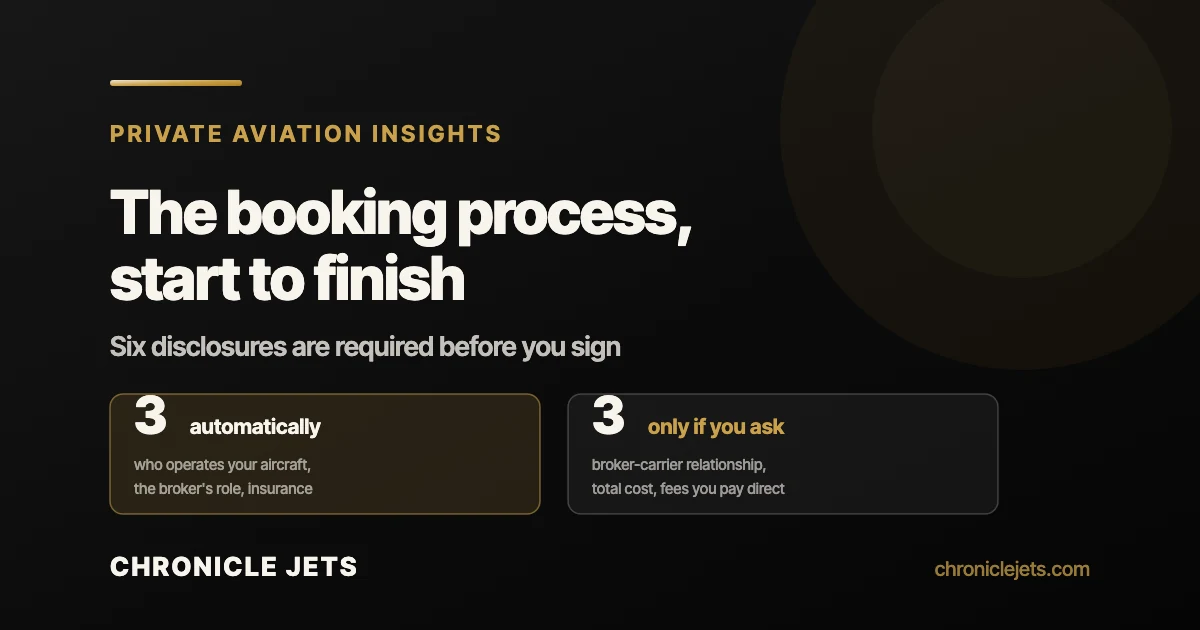
Brokers have federal rules of their own. Under 14 CFR 295.24, before you sign a contract, a broker must tell you the corporate name of the carrier in operational control of the aircraft, the capacity the broker is acting in, and the existence or absence of liability insurance the broker holds covering you. Three more disclosures, including the total cost, are owed if you ask.
That first disclosure is the useful one for a Part 135 check: once you have the operator’s name, you can look it up on the FAA’s list yourself. We give you that name before you book. Our booking process guide shows where it fits in the steps from first inquiry to trip sheet.
Common Questions About Part 135 Charter Rules
These are the questions clients ask most once Part 135 comes up. The short version: the operator holds the certificate, and you can check it yourself.
Is every private jet flight a Part 135 flight?
No. An owner flying their own aircraft for their own purposes is usually operating under Part 91, the general operating rules. When a company supplies the aircraft and crew to carry passengers for hire, it needs an FAA certificate, and the flight falls under Part 135.
How many hours does a Part 135 pilot need?
The pilot in command of a turbojet, or of an airplane with 10 or more passenger seats, must hold an airline transport pilot certificate. In other aircraft, a pilot in command needs at least 500 hours for visual flights or 1,200 hours for instrument flights, along with specific cross-country, night, and instrument time.
How long can a charter crew fly in one day?
For unscheduled crews of one or two pilots, flight time is capped at 8 hours for a single pilot and 10 hours for two pilots in any 24 consecutive hours. Longer flying is only allowed inside a regular duty period of no more than 14 hours, with at least 10 consecutive hours of rest before and after it.
How can I tell if a charter flight is legal?
Ask to see the operator’s Air Carrier or Operating Certificate, and look the operator and the aircraft up on the FAA’s Part 135 list, which is updated weekly. Warning signs the FAA lists include no Federal Excise Tax on the invoice, no safety briefing, and an attempt to hand operational control to you.
Does Chronicle Jets operate the aircraft?
No. Chronicle Jets is an air charter broker, not a direct air carrier. Every flight we arrange is operated by a properly licensed direct air carrier, an FAA Part 135 operator or the foreign equivalent, and we tell you which carrier operates your flight before you book.
Get a quote with the operator named up front