Can a Private Jet Charter Quote Change After You Book?
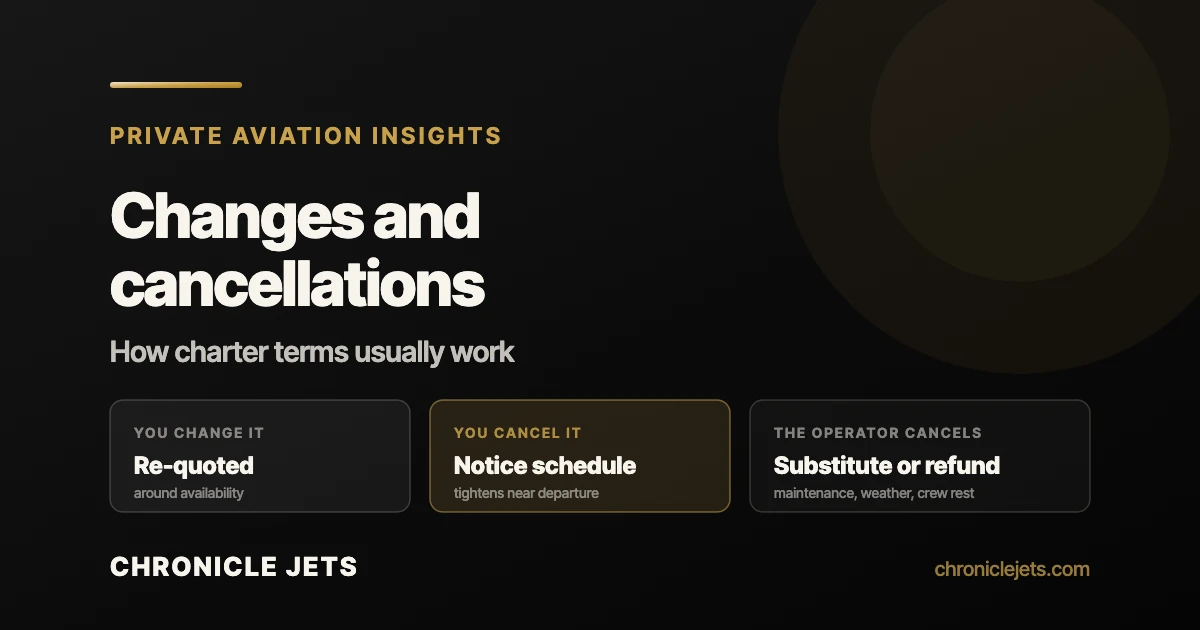
Parts of it can. A charter quote is really two things: a fixed price for the flying you agreed to, and a conditional set of items that depend on what happens on the day. Fuel policy, ground and wait time, de-icing, an airport change, and a change in passengers or luggage are the items that genuinely move. The aircraft rate you signed for the itinerary you signed should not.
TLDR:
- A quote has a fixed part and a conditional part. Most billing surprises come from nobody saying which is which.
- Ground and wait time past the included allowance is the most common real overage.
- De-icing is charged at cost and cannot be quoted in advance with any honesty.
- Changing the airport, the passenger count, or the luggage can change the aircraft, and that changes the price.
- Federal excise tax is a percentage of the amount paid, so anything added carries tax with it.
- A schedule slip that pushes the crew past a duty limit is the expensive one nobody plans for.
- The aircraft rate for the itinerary you signed should not move. If it does, ask why in writing.
- Ask which items are conditional before you sign, and ask for a cap or a not-to-exceed on the ones that are.
Most people describe a charter billing surprise the same way. The number at the end was higher than the number at the start, and nobody had explained that it could be.
The number was usually not wrong. It was conditional, and the conditions were never spelled out. Knowing which parts of a quote can move, and which cannot, is the difference between a surprise and an expected variance.
If you are still comparing options rather than signing one, our guide to comparing an hourly rate against an all-in quote covers what belongs in the number in the first place. This piece picks up after you have chosen.
Want the conditional items named before you sign? Send us the trip, and we will mark which parts of the quote are fixed and which depend on the day.
A Quote Is Two Things Wearing One Number
The fixed part is the aircraft for the itinerary you agreed to. Those hours at that rate, on those dates, between those airports. That should not move unless you move something.
The conditional part is everything that depends on what actually happens: how long the aircraft waits, what the weather does, what the airport charges on the day, and what you decide to add. Those items are real costs that the operator pays and passes through.
A good quote separates them on the page. A weak one gives you a single total and lets you assume it is all fixed. The single most useful question before signing is simply: which lines here can change, and what makes them change?
The Items That Genuinely Move
Ground time and wait time
This is the most common overage by a distance. Your quote includes a certain amount of time on the ground at each stop. Go past it, because a meeting ran long or a car was late, and the extra time is billable.
It is also the easiest one to control, because you know your own schedule better than anyone. If the return leg is genuinely uncertain, say so at quote stage rather than at the aircraft door.
De-icing
De-icing is charged at cost, and it cannot be quoted honestly in advance, because nobody knows on Tuesday what Thursday morning looks like. The amount depends on the aircraft size, the conditions, and the fluid used.
Any winter quote that shows a confident de-icing figure is guessing. What you want instead is confirmation that it is billed at cost with the invoice available.
Fuel policy
Some agreements are fixed on fuel and some carry an escalator that moves with an index. Both are defensible. What is not defensible is finding out which one you signed after the fact.
Ask directly, and if there is an escalator, ask what triggers it and if it is capped.
An airport change
Airports are not interchangeable on price. Landing fees, ramp and handling charges, and overnight parking vary considerably between a large commercial field and a quiet general aviation one nearby.
Moving your arrival airport after booking is a legitimate change, and it changes the cost in both directions. Sometimes it saves money.
Passengers and luggage
This one catches people because it feels administrative rather than financial. Adding passengers or a significant amount of luggage can push the trip past what the assigned aircraft can carry, and the answer is a different aircraft rather than a surcharge.
That is a real re-quote, not a line item. Stepping from a light jet up to a midsize jet changes the aircraft and the number with it. Our guide to matching a jet to the mission covers how those limits interact.
A schedule slip that hits a crew duty limit
The expensive one nobody plans for. Flight crews operate under duty and rest limits, and those limits are not negotiable regardless of who is paying.
If your departure slides late enough, the crew may go out of duty. That can mean an overnight for the crew, a crew change, or a departure the following morning. It is not an upsell, it is a legal limit, and it is the strongest argument for telling your operator early when a schedule starts slipping.
Why Adding Anything Adds a Little More
One mechanic is worth understanding because it applies to every addition at once.
Federal excise tax on domestic commercial air transportation is set by 26 U.S.C. 4261, which imposes a tax on the amount paid for taxable transportation:
There is hereby imposed on the amount paid for taxable transportation of any person a tax equal to 7.5 percent of the amount so paid.
Because it is a percentage of the amount paid rather than a flat fee, anything that increases the transportation charge increases the tax with it. The statute also imposes a separate per-segment amount, which is adjusted over time.
This is not a fee anyone is adding to you. It is the reason a change of a given size lands slightly larger than the change itself on the final invoice.
What Should Not Change
It is as useful to know what is not normal.
The aircraft rate for the itinerary you signed should not move. If the same aircraft flies the same trip on the same dates, that number is the number.
A repositioning cost you were quoted should not reappear as a second charge. If the aircraft had to fly to you, that was knowable at quote stage.
And a tail swap to a different aircraft is sometimes operationally necessary, but it should not quietly cost you more. If the operator substitutes, the price should hold or the change should be explained and agreed before departure.
If any of those move, that is a conversation, not an invoice.
How to Cap the Variable Part Before You Sign
Four questions, asked before you commit, remove nearly all the uncertainty:
- Which lines on this quote are conditional, and what triggers each one?
- How much ground and wait time is included per leg, and what is the rate past it?
- Is fuel fixed or escalating, and if it escalates, is it capped?
- If something changes on the day, who authorizes the extra cost, and how will I be told?
That last one matters more than it looks. The difference between a good operator and a frustrating one is rarely the price. It is if somebody told you before the number moved.
Ask for the answers in writing. A not-to-exceed on the conditional items is a reasonable request and a reasonable operator will give you one.
Common Questions About Charter Quote Changes
What clients ask us most between signing and departure.
Can a charter operator raise the price after I book?
The aircraft rate for the itinerary you signed should not change. What can change are the conditional items: ground and wait time past the included allowance, de-icing, pass-through airport charges, and anything you add or move. Ask which lines are conditional before you sign.
Why was I charged for wait time?
Quotes include a set amount of ground time per leg. Time past that is billable because the aircraft and crew are held for you. If your return timing is genuinely uncertain, say so at quote stage, so the allowance reflects reality.
Why can nobody quote de-icing in advance?
It depends on the conditions on the day, the size of the aircraft, and the fluid used. It is billed at cost. A confident de-icing figure in a winter quote is a guess, and you should ask for the invoice instead.
Does adding a passenger cost extra?
Sometimes it costs nothing, and sometimes it changes the aircraft. It depends on how close the original aircraft was to its seat and weight limits. Tell your broker early, because the answer is occasionally a different aircraft rather than a small addition.
What happens if my meeting runs late and the crew times out?
Crews operate under duty and rest limits that cannot be waived. A long enough delay can mean a crew overnight, a crew change, or departing the next morning. Telling your operator as soon as the schedule starts slipping gives them the most room to solve it.
Why did the tax go up when I added one thing?
Federal excise tax on domestic commercial air transportation is 7.5 percent of the amount paid, so it scales with the total rather than sitting as a flat fee. Any increase in the transportation charge carries a proportional increase in tax.
Can I get a not-to-exceed on the variable items?
It is a reasonable request and worth making. A cap on conditional items, or at least a requirement that someone authorizes extra cost before it is incurred, turns an open question into a known ceiling.
Prefer to know the ceiling before you commit? Tell us the trip, and we will lay out what is fixed, what is conditional, and what each condition would cost.