What Do ARGUS and Wyvern Ratings Actually Tell You?
ARGUS, WYVERN and IS-BAO are voluntary, independent safety programs that sit on top of the FAA Part 135 certificate every legal charter operator must already hold. The certificate proves an operator is allowed to fly you. The ratings are the part that says somebody outside the company has examined how it trains crews, maintains aircraft and manages risk. They are not interchangeable, and none of them are held by a broker. They belong to the operator flying the trip.
TLDR:
- A Part 135 certificate is the legal minimum for charter in the United States, not a mark of distinction.
- ARGUS ratings run Gold, Gold Plus and Platinum, and Platinum requires a two-day on-site audit and a mature safety management system.
- WYVERN runs Wingman Standard and Wingman PRO, built on ICAO and SMICG standards, with PRO adding an assessment of safety culture.
- IS-BAO is a three-stage standard from the International Business Aviation Council, launched in 2002, focused on how deeply safety management is embedded.
- Ratings belong to operators. A broker does not hold them, and any broker implying otherwise is worth a second look.
- Under 14 CFR 295.24 you are entitled to the operator’s corporate name before you sign, and to the full cost breakdown on request.
Most people booking a charter flight never see the layer of the industry this article is about. You call a broker, you get a quote, an aircraft shows up. The vetting happened somewhere in between, and how thoroughly it happened is almost entirely invisible from the outside.
That invisibility is the problem. The vocabulary that gets used to signal safety in charter marketing is genuinely technical, it is easy to misuse, and it is misused often enough that knowing the difference between these programs is a practical consumer skill rather than an academic one.
Ask us who is flying your trip, before you book.
What Does a Part 135 Certificate Actually Prove?
Every legal on-demand charter flight in the United States operates under 14 CFR Part 135. The FAA describes Part 135 as covering commuter and on-demand operations, and it generally applies to aircraft with 30 or fewer passenger seats or a maximum payload capacity of 7,500 pounds or less, which covers essentially the entire business jet fleet.
Getting that certificate is not trivial. An operator has to demonstrate aircraft that conform to Part 135 requirements, maintain manuals and training programs, and staff specific management positions. The FAA distinguishes between Basic operators, whose scope is capped, and Standard operators, who have no preset ceiling on size.
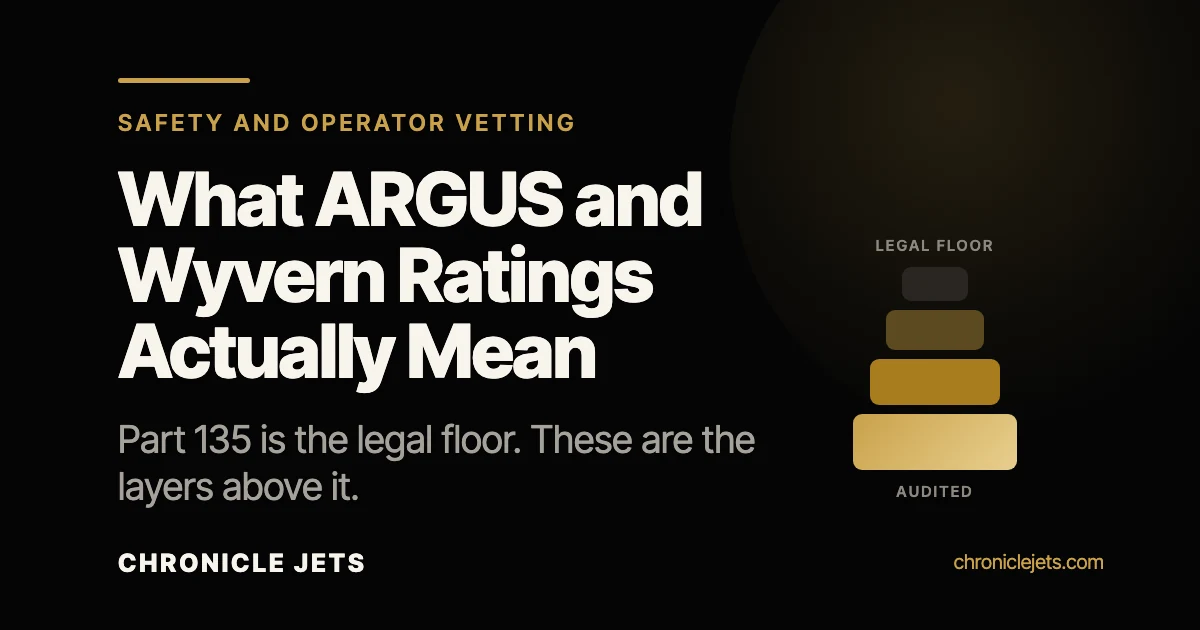
Here is the part that matters for a passenger. The certificate establishes that an operator is permitted to sell you a flight. It does not establish that an independent third party has ever walked their hangar, read their training records, or evaluated whether their safety management system is a document or a practice.
That gap is precisely the space the voluntary programs occupy.
Why the Distinction Gets Blurred
Charter marketing has a strong incentive to make the legal floor sound like an achievement. “Fully certificated” and “FAA approved” are technically accurate and functionally meaningless as differentiators, because every operator you could legally fly with can say the same thing.
The voluntary ratings are meaningful in a way the certificate is not, for a simple reason. An operator can choose not to pursue them, and many do not.
How Do ARGUS Ratings Work?
ARGUS evaluates charter operators through its Charter Evaluation and Qualification process, generally shortened to CHEQ, which combines an operator’s historical safety record with crew and aircraft data. The output is one of three ratings.
Gold requires an operating certificate held for a defined minimum period, pilot background checks, and a historical analysis of the operator’s safety record.
Gold Plus adds an on-site element, satisfied either by an ARGUS on-site safety audit or by maintaining IS-BAO registration.
Platinum is the highest tier. ARGUS states in its own description of the Platinum audit that it involves a two-day on-site evaluation by certified auditors covering training programs, maintenance practices, standard operating procedures and organizational controls. ARGUS also says a defining requirement of Platinum is the implementation and active use of a mature safety management system, and describes the rating as demonstrating a commitment that “goes above and beyond regulatory compliance.”
The practical read is that Gold is largely a records exercise, and the on-site audit is what separates the upper tiers from it.
What Is WYVERN Wingman, and How Is It Different?
WYVERN is the other major name, and it is a genuinely different program rather than a competitor selling the same thing.
WYVERN’s Wingman certification is built around what the company calls the Wingman Standard PASS Report. WYVERN states that the standard is based on ICAO standards for commercial air transport, the Safety Management International Collaboration Group’s standards for safety management systems, and industry best practices.
Wingman comes in two tiers. Wingman Standard is the baseline certification. Wingman PRO goes further, and WYVERN describes it as the level at which it assesses the operator’s safety culture, looking for what it calls “a healthy and generative culture” alongside a safety management system in continuous improvement.
That safety-culture assessment is the interesting part. Records and procedures can be assembled for an audit. Culture is harder to stage.
The Name That Causes the Most Confusion
Wingman is a WYVERN program. It is not an ARGUS program, and the phrase “ARGUS Wingman” describes something that does not exist. The two organizations are separate companies running competing standards.
This matters beyond pedantry. If a broker or an operator page blends the two names together, it is a reasonable signal that the safety language was written by a marketer rather than checked by somebody who works with these programs. It is worth asking a follow-up question.
Every quote we send names the operator and its authority.
Where Does IS-BAO Fit In?
IS-BAO, the International Standard for Business Aircraft Operations, is administered by the International Business Aviation Council. IBAC describes it as a globally recognized voluntary safety standard, launched in 2002 and developed by the business aviation community, and says it is the only ICAO-recognized industry standards program developed specifically for business aviation.
IS-BAO is structured in three progressive stages, and IBAC’s own descriptions of them are worth reading closely because they describe increasing depth rather than increasing paperwork.
Stage 1 confirms that the safety management system infrastructure is established and that safety management activities are appropriately targeted.
Stage 2 ensures that safety risks are being effectively managed.
Stage 3 verifies that safety management activities are fully integrated into the operator’s business and that a positive safety culture is being sustained.
An operator at Stage 3 has been audited three times against a standard that gets harder each time. That is a meaningfully different claim from holding a certificate.
Because IS-BAO measures the maturity of a safety system rather than scoring an operator against a historical record, it complements ARGUS and WYVERN rather than duplicating them. This is also why ARGUS accepts IS-BAO registration as one route to satisfying the Gold Plus on-site requirement.
What Is the Broker’s Actual Job in All This?
A broker does not hold any of these ratings. A broker arranges transportation on aircraft operated by companies that do, and the distinction is not a technicality. It is the legal structure of the industry.
Federal rules recognize this directly. Under 14 CFR 295.20, a broker is not permitted to sell or arrange air transportation performed by a carrier that does not hold the required economic authority from the Department of Transportation and the appropriate safety authority from the FAA. Checking that is not a premium service. It is the condition of operating.
The disclosure rules go further. Under 14 CFR 295.24, before you enter a contract, a broker must tell you the corporate name of the direct air carrier in operational control of the aircraft, the capacity in which the broker is acting, and whether the broker holds liability insurance covering you and your passengers, including when the answer is that it does not.
Three more disclosures are yours on request: the total cost of the transportation including broker fees, carrier-imposed fees and government taxes; the existence and amount of third-party fees such as fuel, landing and hangar charges, with a good-faith estimate where the exact figure is not yet known; and any business relationship between the broker and the carrier that could have influenced which operator you were placed with.
If those disclosures are not provided in time, the rule gives you the right to cancel.
These requirements took effect in February 2019, under the Department of Transportation’s Increasing Charter Air Transportation Options final rule. The Department developed them in response to consumer-protection recommendations from the National Transportation Safety Board following accidents involving brokered flights, which is a useful reminder that the paperwork exists because something went wrong first.
Questions Worth Asking Before You Book
The useful questions are shorter than people expect.
Who holds operational control of this flight, by corporate name? What third-party safety ratings does that operator hold, and at what tier? When was the most recent audit? Do you have a business relationship with this operator? What is the total cost including taxes and fees?
You are entitled to answers to most of that, and a broker who treats the list as an imposition has told you something useful.
Common Questions About Charter Safety Ratings
Is an unrated operator unsafe?
Not necessarily. These programs are voluntary and carry real cost, and some small operators with good records have not pursued them. The absence of a rating is a reason to ask more questions, not an automatic disqualification. The absence of a Part 135 certificate is different, and is disqualifying.
Which rating is the best one?
They measure different things, so the question does not have a clean answer. ARGUS Platinum and WYVERN Wingman PRO both require on-site auditing and a mature safety management system. IS-BAO Stage 3 indicates safety management is embedded across the business. Many well-regarded operators hold more than one.
Can a broker hold an ARGUS or Wyvern rating?
No. These are operator programs. A broker can subscribe to ARGUS data services to check operators, which is a different thing from being rated, and it is worth listening carefully to how that is phrased.
How often are these audits repeated?
They are recurring rather than permanent, which is why the date of the most recent audit is a fair question. Recertification cycles vary by program and tier, so ask for the specific operator rather than assuming.
Does the FAA endorse these ratings?
The FAA sets and enforces the Part 135 requirements. ARGUS, WYVERN and IS-BAO are independent industry programs rather than regulatory ones. IS-BAO is recognized by ICAO as an industry standards program for business aviation, which is a recognition of the standard rather than a government certification of any individual operator.
What if I am booking through a broker I have not used before?
Ask for the operator’s corporate name before you commit, which federal rules already require them to provide. That single name lets you verify certification independently, and a broker unwilling to give it is telling you to book elsewhere.