Can You Bring a Pet on a Private Jet Charter?
Usually, yes, but the operator flying the aircraft decides how. Each operator sets its own pet policy, so share the animal’s weight, crate size, and where it will ride when you first ask for a quote. Leaving the country adds paperwork set by the destination, and dogs entering the U.S. have CDC entry rules of their own.
TLDR:
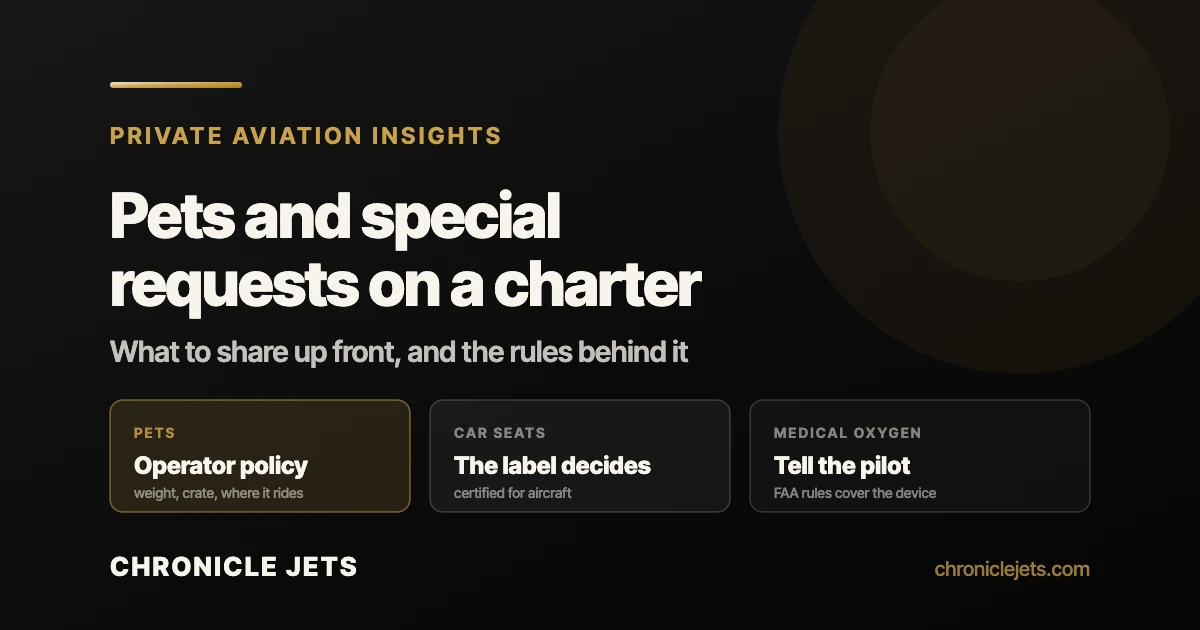
- Pets, car seats, medical oxygen, catering, and oversized gear can all be arranged on a charter. Say so in the first message, not the week of the trip.
- The operator, not the broker, sets pet policy. Rules on size, crates, and cabin placement vary, so ask before you book.
- Anything carried in the cabin has to be restrained under FAA rules, which is why crate size and placement come up.
- Crossing a border with a pet means the destination’s entry rules, a USDA-endorsed health certificate, and for dogs coming into the U.S., the CDC Dog Import Form.
- Car seats need the right label, and portable oxygen concentrators need the right certification.
- On a charter, the operator has to serve any alcohol on board. Bringing your own bottle is a request, not a given.
Private charter is the obvious answer for travelers who do not want the dog in a cargo hold or a toddler on a crowded concourse. The aircraft is yours for the trip, and that changes what is possible.
It does not make everything automatic. A request that arrives late can mean a different aircraft, a missing document, or a crew that was never told. This guide covers what to share, when, and why.
Tell us about the pet when you ask for a quote
Why the Operator Sets the Pet Rules, Not the Broker
A broker arranges the trip. The operator holds the certificate, flies the aircraft, and owns the cabin rules, including the pet policy. Our guide to broker vs operator roles explains that split in detail.
That is why pet answers vary from one aircraft to the next. One operator may allow a large dog in the cabin. Another may require a crate, limit the number of animals, or decline pets on a particular aircraft. Operators set their own rules; ask before you commit.
The federal rule behind the crate question
Part of the answer comes from a cabin rule every charter operator flies under. The FAA’s carry-on rule for Part 135 operators, 14 CFR 135.87, as published in 2026, sets the baseline. No person may carry cargo or carry-on baggage unless it sits in an approved rack, bin, or compartment, is secured by an approved means, or is restrained so it cannot move during turbulence.
The regulation does not mention pets by name. It is still a fair way to understand why operators ask about crate size, weight, and where the animal sits for takeoff and landing. Nothing in the cabin is supposed to shift.
What to Tell Us About Your Pet
A pet request goes faster when it arrives complete. Five details answer most of the questions an operator will ask.
Weight and crate size matter most on smaller aircraft. A large crate that fits easily in a midsize jet may crowd a light jet cabin that is already carrying four passengers and their bags.
Size, temperament, and the people on board
Mention anything the crew should know about the animal’s behavior, and anyone on board with an allergy. A charter cabin is a shared room for the length of the flight, so the other passengers are part of the answer too.
If the animal is a service animal, say so in the same message. An operator’s approach to service animals may differ from its pet policy, so ask about both.
Crossing a State Line or a Border With a Pet
The paperwork depends on where you land, not where you take off. Here the rules come from government agencies, not the operator.
Between U.S. states. The USDA’s animal health agency is direct about this. Its guide to interstate pet travel, as published in 2026, says APHIS “doesn’t regulate the interstate movement of pets by their owners,” and that requirements are “set by the receiving State or Territory.” Check the destination state before you fly.
Leaving the United States. The same agency’s pet export guidance, updated in 2026, notes that the destination country sets pet entry requirements, “which can change at any time.” It advises contacting a USDA-accredited veterinarian as soon as you decide to travel, since that vet helps obtain a USDA-endorsed health certificate.
Bringing a dog into the United States
Dogs face a separate federal check on the way back.
For dogs that have been only in rabies-free or low-risk countries for the past six months, the CDC’s dog entry requirements, as posted in 2024, set three conditions. The dog needs a CDC Dog Import Form receipt and a microchip readable by a universal scanner, and it must appear healthy on arrival. The CDC also states that “dogs must be at least 6 months old at time of entry or return.”
Dogs that have been in a high-risk country face stricter rules. The CDC dog importation page states that a dog “will NOT be allowed to enter the U.S. if it is not vaccinated against rabies and has been in a high-risk country for dog rabies in the past 6 months.” A young puppy or a missing form can end an international trip before it starts, so check these early.
Flying with a pet? Start the paperwork early
Other Special Requests, and the Rules Behind Them
Pets get the attention, but they are one request among many. Several common ones have a federal rule behind them, which is useful to know before you ask.
Catering and drinks
Catering is usually simple to arrange, with lead time and clear preferences. Alcohol has a rule of its own. Under 14 CFR 135.121, as published in 2026, “no person may drink any alcoholic beverage aboard an aircraft unless the certificate holder operating the aircraft has served that beverage.”
In practice, that means a bottle you bring for the flight is a request to the operator, not a given. Ask how they handle it when you book.
Infants, toddlers, and car seats
Federal rules allow a child under two to be held by an adult on a Part 135 flight. If you bring a car seat, it needs the right label. Under 14 CFR 135.128, current U.S. seats must read “THIS RESTRAINT IS CERTIFIED FOR USE IN MOTOR VEHICLES AND AIRCRAFT” in red lettering.
The same section says booster-type, vest-type, and harness-type restraints generally are not approved for use in aircraft. Check the label before you leave home, and tell us the child’s age, so the seat count is right.
Medical oxygen and portable concentrators
Medical oxygen is regulated closely, so it belongs in the first message. The rule at 14 CFR 135.91 requires that the pilot in command be advised when oxygen equipment is on board and when it is intended to be used.
A portable oxygen concentrator must meet that section’s acceptance criteria. That includes a manufacturer label stating the device “conforms to all applicable FAA acceptance criteria” for carriage and use on board. Send the make and model, and the operator can confirm it.
Golf clubs, skis, instruments, and other bulky items
Oversized gear is the request most likely to change the aircraft. The same cabin restraint rule applies, and baggage space differs a great deal between categories. A set of skis or a cello may push a trip from a light jet to something larger.
Our guide to matching a private jet to your mission covers how passengers, luggage, and range work together.
When to Raise Each Request
The earlier a request arrives, the more aircraft can meet it. This table shows what each one depends on and what to send.
| Request | Who decides | What to send |
|---|---|---|
| Pet in the cabin | The operator’s own policy | Species, weight with crate, crate size, where it rides |
| Pet crossing a border | The destination country, plus CDC for dogs entering the U.S. | Destination, travel dates, vet and health certificate status |
| Car seat | FAA labeling rules and the operator | Child’s age and the seat’s label |
| Medical oxygen or concentrator | FAA rules and the operator | Device make and model, and when it will be used |
| Alcohol on board | The operator, which must serve it | What you would like served |
| Bulky gear | Aircraft baggage space | Item, size, and weight |
Anything on this list can reshape the quote, so it belongs in the first message. The private jet charter booking process shows where each detail fits from inquiry to the trip sheet.
Common Questions About Pets and Special Requests on a Charter
These are the questions that come up most often once a pet or a special request is part of the plan. The short version: ask early, and expect the operator’s policy to decide the details.
Can my dog sit on the seat during a private charter flight?
That depends on the operator. Policies vary: some operators may allow a pet on a seat or a lap in flight, and others may require a crate for the whole trip. Federal rules require carry-on items to be restrained, so expect a plan for takeoff and landing. Share the dog’s weight and crate size when you request a quote.
Do I need a health certificate to fly my pet on a private jet?
Within the U.S., the destination state sets the rules, and some require a health certificate. For international trips, the destination country sets the requirements, and a USDA-accredited veterinarian helps obtain a USDA-endorsed certificate. Start as soon as you know the dates, since the process takes time.
What does a dog need to enter the United States?
For dogs that have been only in rabies-free or low-risk countries, the CDC requires a Dog Import Form receipt, a microchip readable by a universal scanner, an age of at least six months, and a healthy appearance on arrival. Dogs from high-risk countries face stricter rules, so check the CDC requirements before you book.
Can I bring my own wine or champagne on a charter?
Under FAA rules for Part 135 flights, no one may drink alcohol on board unless the operator has served it. That makes your own bottle a request to the operator rather than something you simply carry on. Tell us what you would like served, and ask how the operator handles it.
Can I bring a car seat for my toddler on a private jet?
Yes, if it carries the right label. A current U.S. seat must state that it is certified for use in motor vehicles and aircraft, and booster or vest-type restraints are generally not approved. A child under two may also ride on an adult’s lap. Tell us the child’s age when you book.
Put every special request in the first message