Opens in a new tab

Questions to Ask Before You Book a Charter Flight

The questions worth asking before you book a charter flight, who you should be asking, and what a good answer sounds like. Built on the federal broker disclosure rules and the FAA's own advice for charter passengers.
Questions to ask before you book a charter flight: the operator named before you sign, the aircraft on the FAA charter list, and an all-in price

What Should You Ask Before Booking a Private Jet Charter?

Ask who operates the flight, by corporate name, and confirm that exact aircraft is authorized for charter on the operator’s FAA certificate. Ask who holds operational control, what the total cost includes, what insurance the broker holds, and which safety audits the operator holds. A good broker answers all six plainly, in writing, before you sign.

TLDR:

  • The operator flies the aircraft and holds operational control. The broker arranges the trip.
  • Federal rules require a broker to name the operator, state its role, and disclose its insurance before you sign.
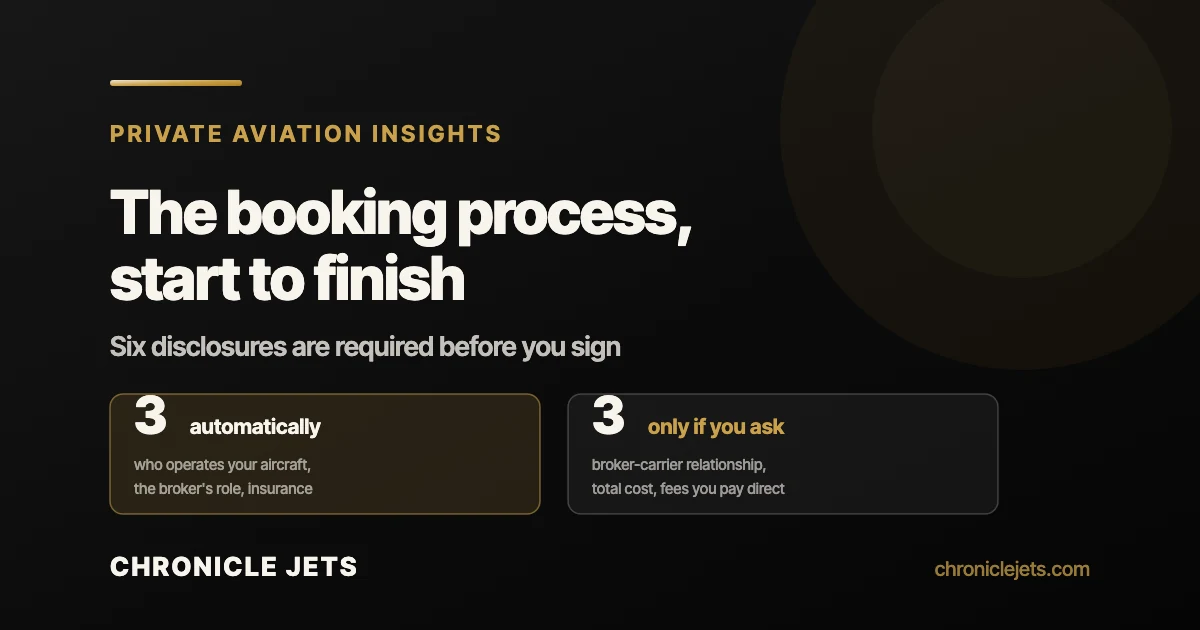
  • Three more disclosures come only if you ask, including the total cost.
  • The FAA tells charter passengers to ask to see the operator’s certificate.
  • You can check the operator and the tail number on the FAA’s Part 135 list yourself.
  • If a required disclosure arrives too late, you can cancel for a full refund.

When a trip out of Ocala or anywhere in Central Florida comes together on short notice, for a meeting, a closing, or a family event, that is exactly when the right questions get skipped. This guide collects them in one place, says who should answer each one, and describes what a good answer sounds like.

Ask us anything on this list before you book

Who Are You Actually Asking: the Broker or the Operator?

Before the questions, it helps to know who sits on the other side of the table. A brokered charter has two companies in it, and the rules give them different jobs.

Under 14 CFR 295.5, an air charter broker holds out, sells, or arranges charter flights using a direct air carrier. The operator is that direct air carrier. It holds the FAA certificate under 14 CFR 119.5, and 14 CFR 135.77 makes each certificate holder responsible for operational control.

Chronicle Jets is an air charter broker. We are not a direct air carrier and do not have operational control of any aircraft. Every flight we arrange is provided by a properly licensed direct air carrier, an FAA Part 135 operator or the foreign equivalent, and we name that carrier before you book.

Who does what on a brokered charter flightThree roles on a brokered charter, drawn from federal rules. You, the charterer: charter the entire capacity of the aircraft (14 CFR 295.5(h)); are owed three disclosures before you sign and can ask for three more, including the total cost (295.24(a)); can cancel for a full refund if disclosures come too late (295.24(c)). The air charter broker: sells and arranges the trip using a direct air carrier (295.5(b)); may use only carriers with FAA and DOT authority (295.20); names the operator, its own role and its insurance (295.24(a)); is not in operational control of any aircraft (295.23). The operator: holds the FAA Air Carrier or Operating Certificate (119.5); holds operational control, meaning it starts, runs and ends the flight (135.77 and 1.1); flies aircraft authorized for charter on its certificate (FAA Part 135 list); its pilot in command sees that passengers are briefed before each takeoff (135.117).Who does what on a brokered charter flightTHREE ROLES, AS FEDERAL RULES DEFINE THEMYOU, THE CHARTERERThe clientCharter the entire capacityof the aircraft295.5(h)Are owed three disclosuresbefore you sign295.24(a)Can ask for three more,including the total cost295.24(a)Can cancel for a full refundif disclosures come too late295.24(c)THE AIR CHARTER BROKERArranges the flightSells and arranges the tripusing a direct air carrier295.5(b)May use only carriers withFAA and DOT authority295.20Names the operator, its ownrole, and its insurance295.24(a)Is not in operational controlof any aircraft295.23THE OPERATORFlies the aircraftHolds the FAA Air Carrieror Operating Certificate119.5Holds operational control:starts, runs, and ends the flight135.77, 1.1Flies aircraft authorizedfor charter on its certificateFAA listIts pilot in command sees thatpassengers are briefed135.117Sources: 14 CFR 1.1, 119.5, 135.77, 135.117, Part 295 (eCFR, 2026); FAA Part 135 operator list, 2026.
Who does what on a brokered charter flightThree roles on a brokered charter, drawn from federal rules. You, the charterer: charter the entire capacity of the aircraft (14 CFR 295.5(h)); are owed three disclosures before you sign and can ask for three more, including the total cost (295.24(a)); can cancel for a full refund if disclosures come too late (295.24(c)). The air charter broker: sells and arranges the trip using a direct air carrier (295.5(b)); may use only carriers with FAA and DOT authority (295.20); names the operator, its own role and its insurance (295.24(a)); is not in operational control of any aircraft (295.23). The operator: holds the FAA Air Carrier or Operating Certificate (119.5); holds operational control, meaning it starts, runs and ends the flight (135.77 and 1.1); flies aircraft authorized for charter on its certificate (FAA Part 135 list); its pilot in command sees that passengers are briefed before each takeoff (135.117).Who does what on abrokered charter flightTHREE ROLES, AS FEDERAL RULES DEFINE THEMYOU, THE CHARTERERThe clientCharter the entire capacityof the aircraft295.5(h)Are owed three disclosuresbefore you sign295.24(a)Can ask for three more,including the total cost295.24(a)Can cancel for a full refundif disclosures come too late295.24(c)THE AIR CHARTER BROKERArranges the flightSells and arranges the tripusing a direct air carrier295.5(b)May use only carriers withFAA and DOT authority295.20Names the operator, its ownrole, and its insurance295.24(a)Is not in operational controlof any aircraft295.23THE OPERATORFlies the aircraftHolds the FAA Air Carrieror Operating Certificate119.5Holds operational control:starts, runs, and ends the flight135.77, 1.1Flies aircraft authorizedfor charter on its certificateFAA listIts pilot in command sees thatpassengers are briefed135.117Sources: 14 CFR 1.1, 119.5, 135.77, 135.117,Part 295 (eCFR, 2026); FAA Part 135 operatorlist, 2026.
A broker arranges the flight. The operator flies it and holds operational control. Sources: 14 CFR Part 295 and 14 CFR 135.77, eCFR, 2026.

So most of the questions below are about the operator, and the broker is the one who should be able to answer them. Our guide to how a broker and an operator split the work goes deeper on the two roles.

Questions About Who Will Fly You

These come first because every other answer depends on them. A price, an aircraft, and a safety record only mean something once you know whose they are.

Who is the operator, by corporate name?

A good answer is a company name, in writing, before you sign. Under 14 CFR 295.24, as published in the eCFR in 2026, a broker must disclose the corporate name of the carrier in operational control, plus any other names it does business under. “One of our partners” is not an answer.

Is this exact aircraft authorized for charter on that certificate?

Ask for the tail number. The FAA publishes a list of Part 135 operators and their aircraft, searchable by operator name or N-number and updated weekly. It shows which aircraft are authorized for charter, not just that the company exists.

Who holds operational control of the flight?

The answer should always be the operator. The FAA defines operational control in 14 CFR 1.1 as authority over starting, conducting, or ending a flight. If a company supplies the aircraft and crew, then hands you a document that shifts that control to you, treat it as a warning sign rather than a formality.

Questions About Safety Standing

Once you know the operator, the next questions are about how it runs. These are where a broker earns its place, because most clients have no easy way to check them alone.

Will the operator show its certificate?

The FAA’s own advice for passengers, on its page Thinking of Chartering an Aircraft? (last updated January 2026), is to ask to see the operator’s Air Carrier or Operating Certificate when you pay for a charter. If the operator refuses, the FAA says to find one that will show it.

Which safety audits does the operator hold, and when was the last one?

Independent audits sit on top of the FAA certificate. A good answer names the audit, the level, and the date, so you can confirm it with the organization that ran it. Federal rules treat a broker’s misrepresentation about an audit standard as a deceptive practice under 14 CFR 295.50, so a rating nobody can show you on paper is a red flag.

Our guide to ARGUS and Wyvern ratings explains the audit names and levels, and our safety standards page covers how we check operators before we book them.

What happens if the aircraft has a mechanical problem?

Ask before you need the answer. A good one describes how a substitute aircraft is found, what category it will be, and how any price difference is handled. Our guide to charter changes and cancellations walks through what a fair substitution looks like.

Questions to ask, and what a good answer sounds likeSix questions to ask before booking a charter flight. 1: Who is the operator, by corporate name? Good answer: a company name in writing before you sign. Red flag: one of our partners. 2: Is this aircraft authorized on that operator’s certificate? Good answer: a tail number you can look up on the FAA Part 135 list. Red flag: no tail number or no certificate shown. 3: Who holds operational control? Good answer: the operator, every time. Red flag: paperwork that hands control to you. 4: What is the total cost with taxes and fees? Good answer: one all-in figure with third-party fees named. Red flag: no federal excise tax on the invoice. 5: What liability insurance does the broker hold? Good answer: it exists or it does not, with limits stated. Red flag: a vague promise you are fully covered. 6: Which safety audits does the operator hold? Good answer: the audit, the level, and the date. Red flag: a rating nobody can show you on paper. Sources: 14 CFR 295.24 and 295.50, FAA Safe Air Charter guidance, 2026.Questions to ask, and what a good answer sounds likeSIX QUESTIONS FOR ANY CHARTER, BEFORE YOU SIGNASKA GOOD ANSWERA RED FLAG1Who is the operator,by corporate name?A company name, in writing,before you sign.“One of our partners.”2Is this aircraft authorizedon that operator’s certificate?A tail number you can lookup on the FAA’s Part 135 list.No tail number, or nocertificate shown.3Who holds operationalcontrol of the flight?The operator. Every time.Paperwork that handscontrol to you.4What is the total cost,taxes and fees included?One all-in figure, with anythird-party fees named.No federal excise taxon the invoice.5What liability insurancedoes the broker hold?It exists or it does not,with the limits stated.A vague promise thatyou are “fully covered.”6Which safety audits doesthe operator hold?The audit, the level, andwhen it was last done.A rating nobody canshow you on paper.Sources: 14 CFR 295.24 and 295.50 (eCFR, 2026); FAA Safe Air Charter guidance, 2026.
Questions to ask, and what a good answer sounds likeSix questions to ask before booking a charter flight. 1: Who is the operator, by corporate name? Good answer: a company name in writing before you sign. Red flag: one of our partners. 2: Is this aircraft authorized on that operator’s certificate? Good answer: a tail number you can look up on the FAA Part 135 list. Red flag: no tail number or no certificate shown. 3: Who holds operational control? Good answer: the operator, every time. Red flag: paperwork that hands control to you. 4: What is the total cost with taxes and fees? Good answer: one all-in figure with third-party fees named. Red flag: no federal excise tax on the invoice. 5: What liability insurance does the broker hold? Good answer: it exists or it does not, with limits stated. Red flag: a vague promise you are fully covered. 6: Which safety audits does the operator hold? Good answer: the audit, the level, and the date. Red flag: a rating nobody can show you on paper. Sources: 14 CFR 295.24 and 295.50, FAA Safe Air Charter guidance, 2026.Questions to ask, and whata good answer sounds likeSIX QUESTIONS, BEFORE YOU SIGN1Who is the operator,by corporate name?GOOD ANSWERA company name, in writing,before you sign.RED FLAG“One of our partners.”2Is this aircraft authorizedon that operator’s certificate?GOOD ANSWERA tail number you can lookup on the FAA’s Part 135 list.RED FLAGNo tail number, or nocertificate shown.3Who holds operationalcontrol of the flight?GOOD ANSWERThe operator. Every time.RED FLAGPaperwork that handscontrol to you.4What is the total cost,taxes and fees included?GOOD ANSWEROne all-in figure, with anythird-party fees named.RED FLAGNo federal excise taxon the invoice.5What liability insurancedoes the broker hold?GOOD ANSWERIt exists or it does not,with the limits stated.RED FLAGA vague promise thatyou are “fully covered.”6Which safety audits doesthe operator hold?GOOD ANSWERThe audit, the level, andwhen it was last done.RED FLAGA rating nobody canshow you on paper.Sources: 14 CFR 295.24 and 295.50 (eCFR, 2026);FAA Safe Air Charter guidance, 2026.
Six questions to ask before you sign, and the answers you should hear. Sources: 14 CFR 295.24 and the FAA guidance for charter passengers, 2026.

Questions About the Money

Price questions are where disclosure rules help you most, because three of the six disclosures in 295.24 are owed only if you ask for them.

What is the total cost, including taxes and fees?

Ask for one all-in figure. On request, a broker must disclose the total cost paid to or through it, including broker or carrier fees and government taxes. The FAA also lists a missing Federal Excise Tax as a red flag, because legitimate operators have to charge it. Our guide to comparing an hourly rate with an all-in quote shows what belongs inside that number.

Are there fees I will pay directly to someone else?

Fuel, landing fees, and aircraft parking or hangar fees can sometimes be paid straight to a third party. On request, the broker must tell you about them, with a good-faith estimate if the exact amount is not known. Also ask which lines are conditional, since a quote can still move after you book when the trip changes.

Do you have a business relationship with this operator?

When the broker is acting as your agent, it must disclose, on request, any corporate or business relationship with the operator that may bear on why that operator was chosen. A good broker answers this one without flinching.

What liability insurance does the broker hold?

This one is owed without asking: 295.24 requires a broker to disclose the existence or absence of its liability insurance covering you, your passengers, and your property, plus the limits.

A plain “we carry this much” or a plain “we carry none” are both honest answers. The operator is separately required by 14 CFR 205.3 to carry liability insurance for aircraft accidents, and its insurance certificate is worth requesting too.

Get the operator named before you sign anything

Questions About the Trip Itself

The last set is about fit. A legal, well-run operator can still send the wrong aircraft if the trip details were thin.

  • Can this aircraft fly the leg nonstop with our actual passengers and luggage? Range figures assume a load. Ask about yours.
  • Will our bags fit? Golf clubs, skis, and large cases are where baggage space starts to matter, and where a light jet and a midsize jet can differ.
  • Can it use the airports we want at both ends? Runway length can rule an aircraft out.
  • How long is our day, including time on the ground? Crew duty and rest limits can turn a long out-and-back into a two-crew or overnight plan.

Our guide to matching an aircraft to the mission covers these inputs in more detail, and Part 135 explained covers the crew limits.

When to Ask Each Question

Timing matters as much as the questions. The disclosure rules attach to specific moments, and knowing them tells you when an answer is late.

When to ask each question, from inquiry to takeoffFive stages of booking a charter. 1 Inquiry: share route, dates, passengers and luggage, and ask who would operate the flight. 2 Quote: ask for the total cost and any fees you pay directly; both are disclosed on request under 14 CFR 295.24(a)(4) and (5). 3 Before you sign: the operator’s name, the broker’s role and the broker’s insurance are owed by now under 295.24(a). 4 Before departure: anything owed or requested must be given before the flight begins under 295.24(d); if it comes too late you can cancel for a full refund under 295.24(c). 5 Day of flight: passengers get an oral briefing before each takeoff under 135.117.When to ask each question, from inquiry to takeoffWHAT IS OWED TO YOU, AND WHEN1InquiryShare route, dates,passengers, luggage.Ask who wouldoperate the flight.Your first call2QuoteAsk for the totalcost and any feesyou pay directly.Both are on request.295.24(a)(4), (5)3Before you signOperator name,broker’s role, andbroker insuranceare owed by now.295.24(a)4Before departureAnything owed orrequested must begiven before theflight begins.295.24(d)5Day of flightPassengers get anoral briefing beforeeach takeoff.135.117Late disclosures carry a right to cancel for a full refund, 14 CFR 295.24(c). Sources: Parts 135 and 295 (eCFR, 2026).
When to ask each question, from inquiry to takeoffFive stages of booking a charter. 1 Inquiry: share route, dates, passengers and luggage, and ask who would operate the flight. 2 Quote: ask for the total cost and any fees you pay directly; both are disclosed on request under 14 CFR 295.24(a)(4) and (5). 3 Before you sign: the operator’s name, the broker’s role and the broker’s insurance are owed by now under 295.24(a). 4 Before departure: anything owed or requested must be given before the flight begins under 295.24(d); if it comes too late you can cancel for a full refund under 295.24(c). 5 Day of flight: passengers get an oral briefing before each takeoff under 135.117.When to ask each question,from inquiry to takeoffWHAT IS OWED TO YOU, AND WHENInquiryShare route, dates,passengers, luggage.Ask who wouldoperate the flight.Your first callQuoteAsk for the totalcost and any feesyou pay directly.Both are on request.295.24(a)(4), (5)Before you signOperator name,broker’s role, andbroker insuranceare owed by now.295.24(a)Before departureAnything owed orrequested must begiven before theflight begins.295.24(d)Day of flightPassengers get anoral briefing beforeeach takeoff.135.11712345Late disclosures carry a right to cancel for afull refund, 14 CFR 295.24(c). Sources: Parts135 and 295 (eCFR, 2026).
What a broker owes you, and when it is due. Sources: 14 CFR 295.24 and 14 CFR 135.117, eCFR, 2026.

Three disclosures are owed before you enter a contract. If anything owed or requested is not known yet, or changes, the broker must send it within a reasonable time, and everything must reach you before the flight begins. If it does not arrive in time, 295.24(c) gives you the right to cancel and receive a full refund.

On the day itself, 14 CFR 135.117 requires the pilot in command to make sure passengers are orally briefed before each takeoff. The FAA lists a missing safety briefing among its red flags. Our booking process guide shows where each step falls from first inquiry to trip sheet.

Red Flags That Should Stop a Booking

A short list of warning signs comes straight from the FAA. Its Safe Air Charter program and its 2026 passenger guidance name these:

  • A company supplies the aircraft and at least one crew member, then tries to transfer operational control to you through a document.
  • No Federal Excise Tax is charged.
  • The price seems too good to be true.
  • There is no safety briefing and no passenger briefing cards.
  • Questions get evasive answers.
  • Someone coaches passengers on what to say if an FAA inspector meets the aircraft.

Any one of these is reason to pause. Two or more is reason to book elsewhere.

Common Questions About Vetting a Charter Before You Book

These questions come up as soon as you start checking a charter. The short version: get the operator’s name first, then check it yourself.

What is the most important question to ask before booking a charter?

Ask who operates the flight, by corporate name. Everything else depends on it. Once you have the operator’s name, you can check its certificate and the aircraft’s tail number on the FAA’s Part 135 list, ask about its safety audits, and compare quotes on equal terms. Federal rules require a broker to give you that name before you sign.

How can I tell if a charter operator is legitimate?

Ask to see the operator’s Air Carrier or Operating Certificate, as the FAA advises, and look up the operator and the tail number on the FAA’s Part 135 list, which is updated weekly. Warning signs the FAA names include no Federal Excise Tax, no safety briefing, evasive answers, and paperwork that hands operational control to you.

Does a charter broker have to tell me who operates my flight?

Yes. Under 14 CFR 295.24, a broker must disclose the corporate name of the carrier in operational control before you enter a contract, along with the capacity the broker is acting in and the existence or absence of liability insurance covering you. If that information changes, the broker must tell you within a reasonable time.

What should I ask about insurance before a charter flight?

Ask the broker what liability insurance it holds covering you, your passengers, and your property, and the limits. That disclosure is owed before you sign. Then ask for the operator’s certificate of insurance, since federal rules require the operator to carry its own liability coverage. Be wary of anyone who simply promises you are fully covered.

What if a broker cannot answer these questions before I sign?

Wait. The operator’s name, the broker’s role, and the broker’s insurance are owed before a contract, and the total cost is yours on request. If a required disclosure only arrives after you sign and too late to act on, federal rules give you the right to cancel and receive a full refund.

Does Chronicle Jets operate the aircraft?

No. Chronicle Jets is an air charter broker, not a direct air carrier, and does not have operational control of any aircraft. Every flight we arrange is provided by a properly licensed direct air carrier, an FAA Part 135 operator or the foreign equivalent, and we tell you which carrier operates your flight before you book.

Book with every answer in writing first
Continue Reading

Related Posts