What Happens If You Change or Cancel a Private Jet Charter?
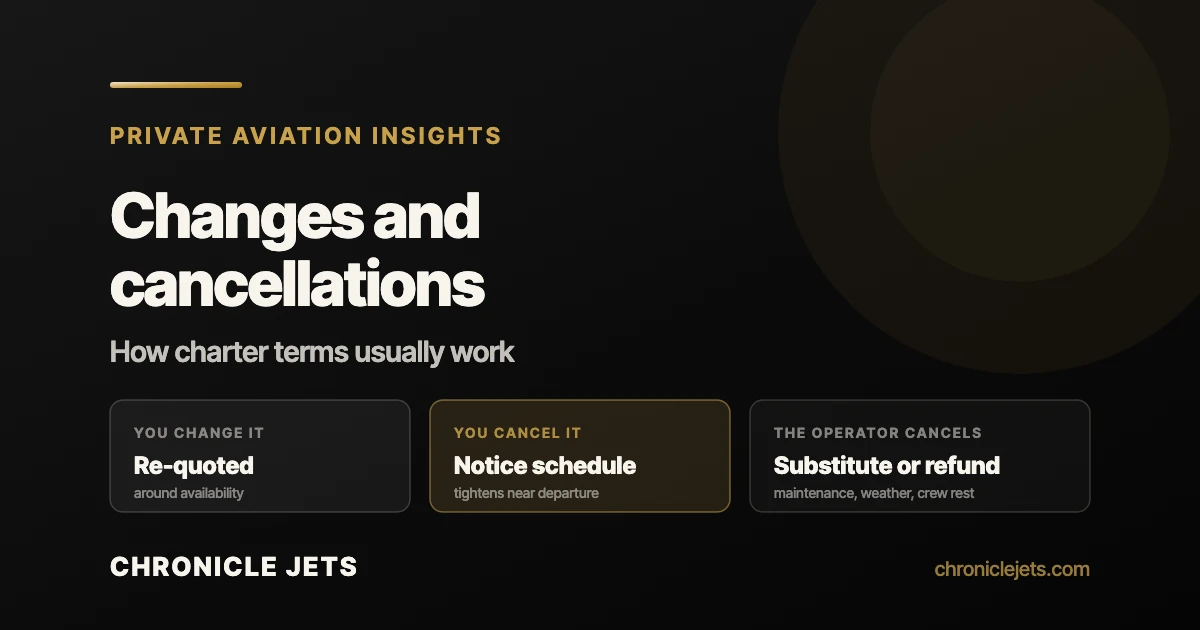
It depends on who made the change. Change the dates, route, or passengers, and the trip is usually re-quoted around what is available. If you cancel, the contract’s cancellation schedule applies, and it gets stricter as departure approaches. If the operator cancels for maintenance, weather, or crew rest, you are typically offered a substitute aircraft or a refund. The exact terms live in your contract.
TLDR:
- There are three different events here: you change the trip, you cancel it, or the operator cancels it. Each one follows different terms.
- A cancellation schedule is typically tiered by notice. The closer to departure, the larger the share the operator keeps.
- A date change can be treated as a cancellation plus a new booking. Ask how your contract reads.
- Operators cancel for reasons nobody can override: an aircraft that is not airworthy, weather the pilot will not fly in, or a crew that needs its legal rest.
- A substitute aircraft should be comparable, disclosed before departure, and agreed by you.
- Federal rules let you cancel with a full refund if your broker does not tell you about certain changes within a reasonable time.
- Get the notice windows, the substitution policy, and the refund method in writing before you sign.
Plans move. A meeting slides a day, a guest drops out, a storm sits over the destination. None of that has to be expensive if you know which terms apply before you make the call.
The trouble is that most people treat every change as the same event. It is not. Who started the change decides almost everything that follows, and the price side of a change is its own subject, covered in what can change your charter quote after you book. This piece covers schedules, cancellations, and refunds.
Know the cancellation terms before you sign
Three Kinds of Change, and Who Starts Each One
Sort any change into one of three columns before you do anything else. The column tells you which part of the contract to read.
You change the trip. New dates, a new departure time, a different airport, more or fewer passengers. The trip still happens, just not the one you signed for, so the operator re-checks availability and usually re-quotes.
You cancel the trip. The flight is not going to happen at all. This is where the cancellation schedule in your contract applies, and where timing matters most.
The operator cancels or substitutes. The aircraft, the weather, or the crew makes the original flight impossible. The question stops being what you owe and becomes what you are offered instead.
The column that costs the most when it goes wrong comes first.
How a Cancellation Schedule Is Usually Built
Charter contracts do not share one standard cancellation policy. Each operator writes its own, and the broker’s agreement with you generally reflects it. The structure, though, tends to look alike.
Most schedules are tiered by notice. Cancel well ahead of departure and the operator keeps a smaller share of what you paid, or none. Cancel inside a shorter window and it keeps more. A same-day cancellation or a no-show may cost most or all of it.
The logic behind the tiers is simple. Once you book, the operator holds that aircraft and crew for you and turns away other trips for the same dates. The later you cancel, the less chance it has to fill that time again.
Details that decide which tier you land in
Three small clauses matter more than the headline tiers. Read them before you sign, not after you cancel.
- How notice is given. Many contracts require written notice. A voicemail may not start the clock.
- When the clock is measured from. Scheduled departure time, and in whose time zone.
- What counts as a cancellation. Some contracts treat a date change, or a shorter itinerary, as a cancellation of the original trip plus a new booking.
That last clause can put a change in the cancellation column without anyone calling it one.
Changing the Trip Instead of Canceling It
A change is usually easier to absorb than a cancellation, because the operator still flies you. The limit is availability. The aircraft you signed for may already be committed on the new date.
Moving a departure by a few hours is often simple. Moving it by days may mean a different aircraft, and adding passengers or luggage can push the trip out of a light jet and into a midsize jet. Each of those is a new quote, and the price mechanics are covered in our guide to charter quote changes after booking.
The practical rule is to say something as soon as you know. A change raised a week out still has options. The same change raised at the aircraft door has far fewer, and a late departure can run into crew rest limits, which the next section explains.
Plans shifting? Call before the window closes
When the Operator Cancels or Substitutes the Aircraft
Sometimes the change comes from the other side. When it does, it is typically for one of three reasons, and each one rests on a federal rule rather than a preference.
Maintenance
An aircraft that is not fit to fly does not fly. The general operating rules in 14 CFR 91.7, as published in 2026, are direct about it:
No person may operate a civil aircraft unless it is in an airworthy condition.
A mechanical issue found before departure means a cancellation or a substitution. Nobody can negotiate around it.
Weather
The call belongs to the pilot. Under 14 CFR 91.3, the pilot in command “is directly responsible for, and is the final authority as to, the operation of that aircraft.” If the pilot decides the conditions are not safe, the flight waits or does not go.
Contracts differ on how a weather cancellation is settled. Some reschedule, some refund, and some treat it differently depending on when the call is made. Ask which applies to you.
Crew rest
Flight crews work under legal rest requirements that cannot be waived for a late passenger. For unscheduled one- and two-pilot crews, the rule in 14 CFR 135.267, checked in 2026, requires each assignment to include:
at least 10 consecutive hours of rest during the 24-hour period that precedes the planned completion time of the assignment
A long enough delay can push a crew past what its day allows. The result may be an overnight, a replacement crew, or a departure the next morning.
What a fair substitution looks like
When the original aircraft cannot fly, the usual remedy is a replacement. A fair one is comparable in cabin, range, and seating, is disclosed to you before departure, and is something you agree to rather than find out about on the ramp. If nothing comparable is available, you should expect the choice of a refund. Our guide to how charter brokers vet operators covers how a replacement operator should be checked.
What Federal Rules Say When the Facts of Your Trip Change
This is the part almost nobody explains. Air charter brokers operate under DOT rules in 14 CFR Part 295, and those rules do not stop at the contract.
Before you sign, a broker owes you six disclosures, including the name of the carrier in operational control of the aircraft. Our booking process guide lists all six. What matters here is what happens when one of them changes afterward, for example because a different carrier will fly the trip.
Under 14 CFR 295.24, as the rule read in 2026, a broker must pass along new or changed information “within a reasonable time after such information becomes available.” If it does not, the rule is specific about the remedy:
air charter brokers must provide the charterer with the opportunity to cancel the contract for charter air transportation, including any services in connection with such contract, and receive a full refund of any monies paid for the charter air transportation and services.
The same section covers a change after the trip has begun. There, the remedy is the opportunity to “cancel the remaining portion of the contract” with a full refund for the part not yet provided.
Two more provisions are worth knowing. Section 295.50 treats it as an unfair or deceptive practice for a broker to represent that a flight has been arranged “without a binding commitment” from the carrier. A confirmed booking should mean a confirmed aircraft.
And section 295.26 requires prompt refunds “when such transportation cannot be performed,” with a deadline of 20 days after a complete refund request for cash and check purchases. Credit card refunds follow the separate rules that section references.
What to Get in Writing About Changes and Cancellations
None of this helps if you learn the terms after the fact. Six answers, in writing, cover almost every situation described above.
- What are the cancellation windows, and what is kept in each one? Ask for the actual schedule, not a summary.
- How do I give notice, and when does the clock start? Written or verbal, and measured against which time zone.
- Is a date change treated as a change or as a cancellation? This is the clause that surprises people.
- If the operator cancels, what happens? A comparable aircraft, a refund, or my choice between them.
- How is a weather cancellation settled? Rescheduled, refunded, or handled some other way.
- How and when is a refund paid? The method, the timing, and who issues it.
A broker who answers all six plainly, before you sign, is telling you how the relationship will go when something moves. The broker vs operator guide explains who holds which part of the contract.
Common Questions About Charter Changes and Cancellations
Short answers to the questions that come up once a trip is on the calendar.
Can I cancel a private jet charter and get my money back?
Often, in part or in full, depending on timing. Most contracts use a cancellation schedule tiered by notice, so canceling well ahead usually costs less than canceling close to departure. The exact windows and amounts are set by your contract, so ask for the schedule in writing before you sign.
Is changing my travel date the same as canceling?
Not always, and this is worth checking. Some contracts treat a date change as a simple change subject to availability. Others treat it as a cancellation of the original trip plus a new booking, which can bring the cancellation schedule into play. Ask how your contract reads before you need it.
What happens if the operator cancels my flight?
The usual remedy is a comparable replacement aircraft, disclosed to you and agreed before departure. If nothing comparable is available, you should expect the choice of a refund. Federal rules also require brokers to make prompt refunds when the transportation cannot be performed.
Will I be refunded if my charter is canceled for weather?
It depends on the contract. The pilot in command has final authority over the flight, so a weather call is not negotiable, but how it is settled varies. Some agreements reschedule, some refund, and some depend on timing. Ask which applies to your trip before you book.
Can the operator swap my aircraft without telling me?
It should not. A substitution should be comparable and disclosed before departure. If the carrier in operational control changes, federal rules require your broker to tell you within a reasonable time, and if that does not happen, you may cancel and receive a full refund.
How long does a charter refund take?
For cash and check purchases, federal rules for air charter brokers set a deadline of 20 days after a complete refund request. Credit card refunds follow separate rules referenced in the same regulation. Submit the request in full and in writing, so the clock starts cleanly.
Get the change terms in writing, then book