What Is the Difference Between an Hourly Rate and an All-In Quote?
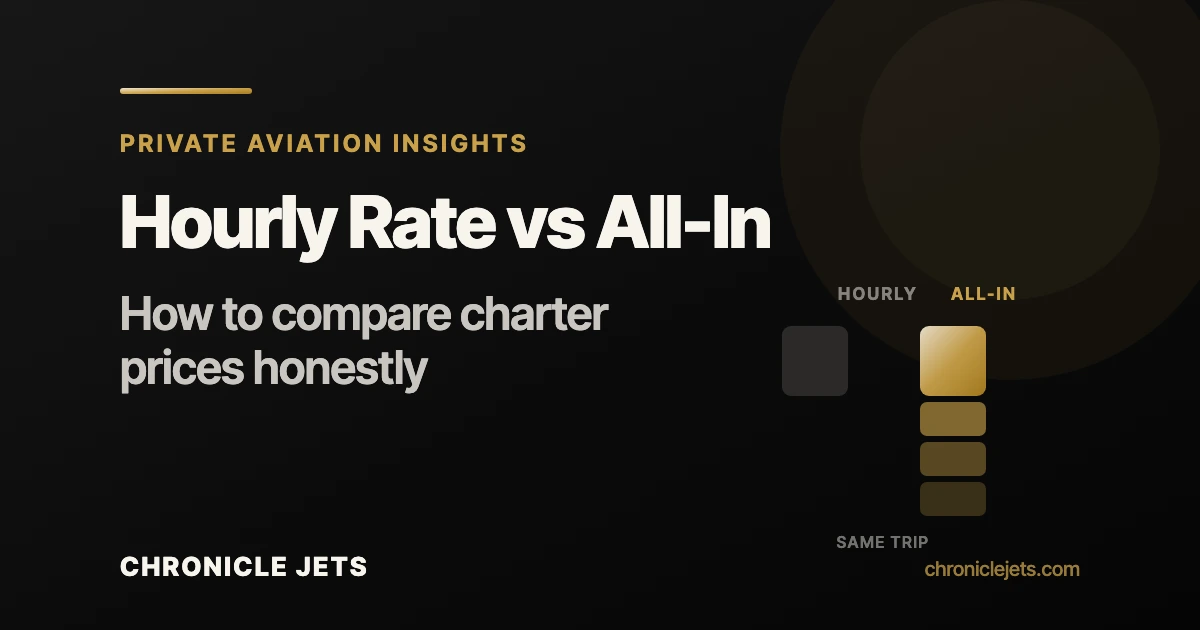
An hourly rate is the price of flight time on a given aircraft. An all-in quote is the total price of your trip, including repositioning, crew costs, taxes, fees, and ground charges. A lower hourly rate can produce a higher final invoice, so the two numbers are not comparable and should never be weighed against each other.
TLDR:
- An hourly rate prices one input. An all-in quote prices the trip you are actually taking.
- Repositioning time to reach you, and to leave afterward, is usually billed even though you are not on board.
- Federal excise tax and segment fees apply to charter and are not optional line items.
- Landing, ramp, and handling charges accrue at both ends of every leg.
- Crew duty limits and overnight stays add cost on multi-day trips.
- Two quotes are only comparable when both are stated as one all-in number for the same itinerary.
- Ask for the total before you compare anything. A quote that resists that question has told you something.
For flyers working out of Ocala International Airport and the wider Central Florida area, this is the single most common source of surprise on a first charter invoice. The rate that got quoted on the phone was real. It just was not the price. Understanding where the gap comes from makes every quote you receive afterward easier to read.
Get one all-in number you can plan around
Why an Hourly Rate Is Not a Price
An hourly rate answers a narrow question: what does this aircraft cost per hour in the air? That is genuinely useful information. It is just not the thing you are buying.
You are buying a trip. The trip has a departure airport, a destination, a date, a passenger count, and a return or a one-way ending. Each of those details changes what the aircraft has to do, and much of what it has to do happens with nobody sitting in the cabin.
Compare two offers on hourly rate alone, and you are comparing one component of two different totals. The operator quoting the lower rate may be based four hours away. The operator quoting more may have an aircraft sitting on the ramp where you are standing. On a short regional trip, that difference alone can flip which one costs less.
What Sits Outside the Hourly Number
Most of the gap between a rate and an invoice comes from a short, predictable list. None of it is hidden in the sense of being improper. It is simply not included in the figure people quote first.
Repositioning. If the aircraft is not already where you are, someone pays for it to get there, and for it to leave when you are done. The industry calls these deadhead or ferry legs. The IRS treats this as part of what you paid for transportation: in the December 2025 revision of Publication 510, Excise Taxes, amounts paid for taxable air transportation explicitly include layover or waiting time and movement of aircraft in deadhead service. If the federal government counts it as part of your fare, so should your quote.
Daily minimums. Many operators bill a minimum number of flight hours per day the aircraft is committed to you. Fly twenty minutes each way on a day trip, and you may still be charged against that minimum, because the aircraft was not available to anyone else.
Crew costs. Pilots operate under federal duty and rest limits. A trip that runs long, starts early, or stays overnight can require crew accommodation, per diem, or in some cases a second crew. Multi-day itineraries carry these more often than people expect.
Taxes and segment fees. Federal excise tax applies to amounts paid for domestic charter, along with per-passenger segment fees. These are statutory. An operator or broker cannot waive them, and federal disclosure rules entitle you to the full cost breakdown on request, and a quote that omits them is incomplete rather than competitive.
Landing, ramp, and handling. Every airport at every end of every leg has its own charges. Ramp fees, facility fees, and handling vary widely by airport and by the fixed base operator you use. Two airports twenty minutes apart can differ meaningfully.
Ground items. Catering, de-icing in the right season, Wi-Fi on some aircraft, and ground transportation are commonly billed as incurred rather than folded into a headline rate.
What an All-In Quote Should Contain
An all-in quote is not a vague promise of “no surprises.” It is a specific document with a specific shape.
It states one total for your itinerary as described. The components behind that total appear as separate lines so you can see the flight time, the repositioning, the taxes and fees, and the ground charges for what they are. It names the operator flying the aircraft. Estimated items are marked as estimates rather than passed off as fixed, which usually means the incurred charges like catering or de-icing. And the quote says what would change the number, so a schedule shift does not arrive as a shock later.
The itemization matters more than the total. A single number with nothing behind it is just a different kind of guess, and it gives you no way to tell a well-priced trip from a badly structured one.
Comparing two charter offers? Send us both
How to Compare Two Quotes Without Guessing
The comparison only works when both sides describe the same trip. That sounds obvious, and it is where most comparisons quietly fail.
Give both parties the identical brief: same departure airport, same destination, same dates and times, same passenger count, same luggage, same return arrangement. Then ask each for one all-in total for that brief. Any difference you see afterward is a real difference in price rather than a difference in what got included.
Watch for the three things that most often make an apples-to-apples comparison fall apart. One quote may assume a different airport, and a smaller field nearby can carry different handling costs. One may assume the aircraft waits for you while the other assumes it leaves and returns, which changes the repositioning math entirely. And one may quote a different aircraft class than you asked for, which is worth checking against our guide to private jet categories before you assume the cabins are equivalent.
If the numbers still sit far apart after all that, the remaining explanation is usually aircraft position. The operator with metal already nearby has less repositioning to recover, which is the same economics that makes an empty-leg flight cheaper when the timing happens to line up.
When Hourly Pricing Is Actually Useful
None of this makes hourly rates useless. They are the right tool for a specific job.
Hourly rates are how you compare aircraft rather than trips. When you are deciding among a light jet, a midsize, and a super-midsize for the same mission, the hourly figures tell you something real about relative operating cost. They also help when you fly a repeatable route often enough that the fixed elements stay constant, because then the variable is genuinely flight time.
What hourly rates cannot do is tell you what one specific trip will cost. For that you need the total, built from your actual itinerary. Use hourly rates to narrow the aircraft, then get an all-in quote to price the flight.
The Questions That Force a Quote Into the Open
You do not need aviation expertise to pressure-test a quote. Five questions do nearly all the work.
Ask what the total is including all taxes and fees. Where is the aircraft coming from, and where does it go afterward? That one surfaces repositioning immediately. Which lines are estimated rather than fixed, and what would change this number? Between them, you get the terms without reading them cold. Then ask who is operating the flight.
That last one is not a pricing question, but it belongs in the same conversation. Air charter brokers work under federal disclosure rules that require them to name the operator, state their own role in the transaction, and on request provide the total cost of the charter including taxes and fees. Our guide to the difference between a broker and an operator covers why the answer changes what you are buying. Our approach to operator vetting and safety standards explains what we check before we put a client on an aircraft.
A quote that answers all five without friction is usually a quote you can trust. One that gets vague on any of them has given you useful information about how the rest of the trip will go.
Common Questions About Private Jet Charter Pricing
These come up on nearly every first charter conversation we have with Central Florida flyers. If your situation is not here, call us, and we will price your specific route out loud.
Why is one operator’s hourly rate so much lower?
Position, aircraft age, or what the rate leaves out. An operator based far from your departure airport has to fly the aircraft to you, and that time is billed somewhere. Older aircraft often carry lower rates. And some rates simply cover less. The only way to tell which explanation applies is to ask both parties for an all-in total on the same itinerary.
Do I pay for the jet to fly to me?
In most cases yes, in some form. If the aircraft is not based where you are departing, the repositioning legs to reach you and to leave afterward are part of what the trip costs. Federal excise tax rules treat movement of aircraft in deadhead service as part of the amount paid for transportation, which reflects how the industry actually bills it.
What taxes apply to a private charter flight?
Domestic charter carries federal excise tax on the amount paid, plus per-passenger domestic segment fees. International itineraries have their own structure. These are set by statute rather than by the operator, so they should appear in your quote as line items rather than arriving later as an adjustment.
What is a daily minimum, and will it affect my trip?
It is a minimum number of flight hours an operator bills per day the aircraft is dedicated to you. It matters most on short trips and on multi-day itineraries with long ground time, because the aircraft cannot be sold to anyone else while it waits. Ask up front what the minimum is and how your itinerary sits against it.
Can an all-in quote still change after I book?
It can, but only for specific and disclosable reasons. Fuel adjustments, de-icing, a schedule change you request, extended crew duty, or catering added later are the usual causes. A good quote tells you in advance which lines can move and why, so nothing on the final invoice is a surprise.
Is a broker’s all-in quote more expensive than going direct?
Not by default. A broker prices your trip across multiple operators rather than presenting one fleet’s availability, which often finds a better-positioned aircraft for the same mission. What matters is transparency: you should see the total, the operator name, and the components, and be able to ask what each line represents.
Send us the trip, not just the route